Fossil Forests of the Yellowstone National ParkKnowlton, Frank Hall
Science
Fossil Forests of the Yellowstone National Park
Knowlton, Frank Hall
Paleobotany -- Yellowstone National Park; Petrified forests; Trees, Fossil -- Yellowstone National Park
The fossil forests are surrounded by a matrix that is known as an acidic
lava—that is, a siliceous lava—which contains abundant silica in
solution. The first part of the process of silicification may well have
been that above described as taking place in the hot spring areas at the
present day—that is, the silica would be deposited in all the cells and
vessels of the wood, making an accurate cast of all open spaces. Then,
while the slow process of decay went on, as each particle of organic
matter was removed its place was taken by the silica, until, finally,
all the wood substance had disappeared and its place atom by atom had
been taken by silica.
By this or a similar process the wood has been preserved or fossilized
with remarkable fidelity: in fact, thin sections or slices of the fossil
wood may be studied under the higher powers of the microscope with
almost or quite as much completeness and satisfaction as if they were
sections cut from a piece of living wood. Each cell and vessel, with its
characteristic pits and markings, is preserved exactly as it grew. Some
of the wood, however, was evidently more or less decayed before it was
fossilized, or else decay worked faster than replacement, so that in
some fragments the structure is not so clearly preserved. Many of the
trunks were subjected to pressure before replacement was complete, and
this has crushed or distorted the cells. On the whole, however, the wood
is exceptionally well preserved, as may be seen in figures 12, 13, 14,
and 15. These are all magnified 100 diameters and were photographed
directly from the thin sections—that is, they are photomicrographs—and
have not been retouched in any manner. Figure 12 shows a transverse
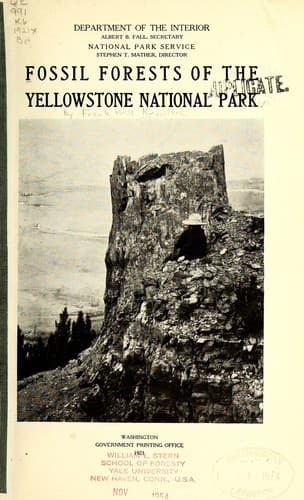
section of the wood of the large redwood trunk that has been so often
mentioned (see title page). The section is cut through one of the growth
rings, which consists of 12 or 15 rows of very thick-walled cells. The
large, regular thin-walled cells, which begin abruptly above the growth
ring, belong to the spring wood—that is, the wood first formed after
growth starts in spring, when the supply of nourishment is abundant. If
there is sufficient moisture and all conditions are favorable this
vigorous growth of wood cells may continue without interruption until
the approach of cold or dry weather, but not infrequently there may be a
brief shortage of moisture, and this is reflected in the formation of a
few rows of thicker-walled cells. Such a condition may be observed in
the present specimen, in which a slight, partial ring may be seen at
some distance above the main ring.
[Illustration: Fig. 12.—Thin section of wood of fossil redwood
(Sequoia magnifica), showing growth ring. Section transverse.
Magnified 100 diameters.]
[Illustration: Fig. 13.—Thin section of wood of fossil pine
(Pityoxylon amethystinum), showing growth ring and resin tube.
Section transverse. Magnified 100 diameters.]
Public-domain text, read in full here on John Shaqi.
Reviews
Reviews
No reviews yet
Be the first to share your thoughts on this work.
Join the Discussion
Join the discussion
Sign in to leave a comment or review.
Sign InorCreate an account