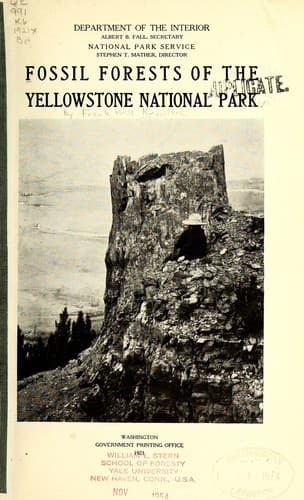
Fossil Forests of the Yellowstone National ParkKnowlton, Frank Hall
Science
Fossil Forests of the Yellowstone National Park
Knowlton, Frank Hall
Paleobotany -- Yellowstone National Park; Petrified forests; Trees, Fossil -- Yellowstone National Park
[Illustration: Fig. 14.—Thin section of wood of fossil pine
(Pityoxylon aldersoni), showing medullary rays and resin tube.
Section tangential. Magnified 100 diameters.]
[Illustration: Fig. 15.—Thin section of wood of fossil laurel
(Laurinoxylon pulchrum), showing wood cells, tubes, and rays.
Section longitudinal. Magnified 100 diameters.]
The very perfect preservation of the wood of one of the pines
(_Pityoxylon amethystinum_) is shown in figure 13, a view of a section
cut through a part of a growth ring and into the spring and summer wood,
the rings in this species being so broad that it is impossible to show a
complete one. The opening near the bottom of the figure shows one of the
large resin ducts, which, in the living wood, is filled with the “pitch”
that so readily exudes when a branch is cut or broken. A longitudinal
section of the other species of pine (_Pityoxylon aldersoni_) is shown
in figure 14. The many little rows of superimposed cells in the midst of
the long wood cells are the cut-off ends of what are known as medullary
rays—that is, the little plates of cells that connect pith and bark. One
of the resin cells cut in the long direction is shown near the center of
the figure; the contents are much darker than that of the wood cells.
The very great difference between the sections of coniferous wood just
described and the wood of a deciduous tree is brought out in figure 15,
which is a longitudinal section of a laurel (_Laurinoxylon pulchrum_).
In this the wood cells are relatively much smaller and shorter, and the
medullary rays are in several irregular rows. The large dotted duct near
the middle of the figure is a feature not present in coniferous trees.
SPECIES REPRESENTED.
An enumeration of the kinds of trees that are represented by the woods
in the fossil forests of the Yellowstone National Park will naturally be
demanded. A superficial or macroscopic examination of these trunks would
not permit a close decision as to the kind of wood: in fact, it would
hardly be possible to do more than separate them by this means into
coniferous and dicotyledonous trees. But by studying thin sections under
the microscope it is possible to distinguish the different kinds with
reasonable accuracy. As the result of such study the following species
have been detected:
Magnificent redwood (Sequoia magnifica).
Alderson’s pine (Pityoxylon aldersoni).
Amethyst pine (Pityoxylon amethystinum).
Laurel (Laurinoxylon pulchrum).
Aromatic bay (Perseoxylon aromaticum),
Hayden’s sycamore (Plantaninium haydeni).
Knowlton’s sycamore (Plantaninium knowltoni).
Felix’s buckthorn (Rhamnacinium radiatum).
Lamar oak (Quercinium lamarense).
Knowlton’s oak (Quercinium knowltoni).
Public-domain text, read in full here on John Shaqi.
Reviews
Reviews
No reviews yet
Be the first to share your thoughts on this work.
Join the Discussion
Join the discussion
Sign in to leave a comment or review.
Sign InorCreate an account