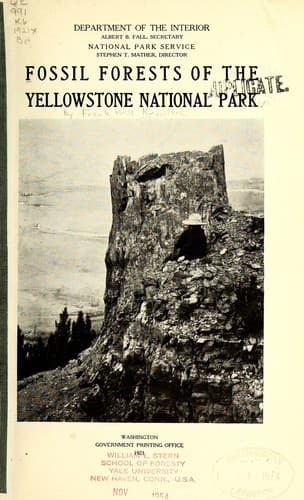
Fossil Forests of the Yellowstone National ParkKnowlton, Frank Hall
Science
Fossil Forests of the Yellowstone National Park
Knowlton, Frank Hall
Paleobotany -- Yellowstone National Park; Petrified forests; Trees, Fossil -- Yellowstone National Park
Although only three kinds of coniferous trees have thus far been found
in the fossil forests of the park, fully 95 per cent of all the trunks
belong to these three species. The preponderance of conifers is probably
due to the facts that they were presumably more abundant in the
beginning, and that, in general, coniferous wood decays less rapidly
than that of most of deciduous-leaved trees. But the conditions were so
favorable for preserving any wood that it is perhaps strange that not
more trunks of deciduous-leaved trees have been found there. As it is,
however, a greater number are known from the park than from any other
region. Thus, the Arizona fossil forests embraced only two species of
deciduous-leaved trees: the Calistoga (California) wood only one
species, and the forest at Cairo, Egypt, only four species.
The 10 species of trees represented in the fossil forests of the park
are by no means the only fossil plants that have been found. The
fine-grained ashes and volcanic mud in which the forests were entombed
contain also great numbers of impressions of plants, many of them very
perfectly preserved. Most of these are impressions of foliage, such as
fronds and leaves, but they include also roots, stems, branches,
fruiting organs, and even what is believed to be the petals of a large
magnolia flower. About 150 different kinds of fossil plants have been
found in the park, 80 in the same beds with the forests, and most of the
others in slightly higher and younger beds. The list embraces 10 ferns,
among them a fine chain fern (Woodwardia), several aspleniums, and a
beautiful little climbing fern (Lygodium). The horse-tails (Equisetum)
are represented by 4 species. The conifers include no less than 6
species of pines (Pinus), a yew (Taxodium), and 2 sequoias. These have
been identified either from the foliage or the cones, and it is more
than likely that some of the specimens may represent organs that
belonged to trees represented by the fossil trunks, but as they have
never been found connected they have been described separately. The
monocotyledons, or plants with parallel-veined leaves, are represented
by only a few forms, such as a single large grass (Phragmites), a few
sedges (Cyperacites), a smilax, and a curious broad-leaved banana-like
plant (Musophyllum). The dicotyledons, or deciduous-leaved plants, make
up the bulk of the flora and include walnuts (Juglans), hickory nuts
(Hicoria), bay berries (Myrica), poplars (Populus), willows (Salix),
birches (Betula), hazel nuts (Corylus), beech nuts (Fagus), chestnuts
(Castanea), oaks (Quercus), elms (Ulmus), figs (Ficus), breadfruits
(Artocarpus), magnolias (Magnolia), laurels (Laurus), bays (Persea),
cinnamons (Cinnamomum), sycamores (Plantanus), acacias (Acacia), sumachs
(Rhus), bittersweet (Celastrus), maples (Acer), soap berries (Sapindus),
buckthorns (Rhammus), grapes (Cissus), basswood (Tilia), aralias
(Aralia), dogwoods (Cornus), persimmons (Diospyros), ash (Fraxinus), and
Public-domain text, read in full here on John Shaqi.
Reviews
Reviews
No reviews yet
Be the first to share your thoughts on this work.
Join the Discussion
Join the discussion
Sign in to leave a comment or review.
Sign InorCreate an account