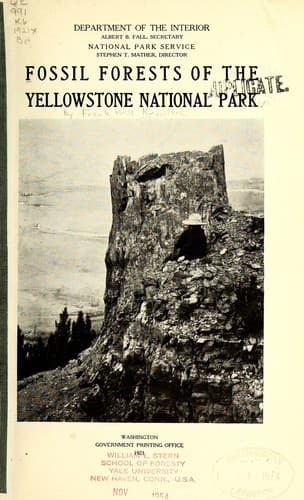
Fossil Forests of the Yellowstone National ParkKnowlton, Frank Hall
Science
Fossil Forests of the Yellowstone National Park
Knowlton, Frank Hall
Paleobotany -- Yellowstone National Park; Petrified forests; Trees, Fossil -- Yellowstone National Park
The question is often asked, How old are the fossil forests? It is, of
course, impossible to fix their age exactly in years, though it is easy
enough to place them in the geologic time scale. The stratified rocks
that make up the crust of the earth, from the oldest we know to the most
recent, have been divided by geologists into a number of major divisions
or systems, each—except perhaps the oldest—containing the remains of
certain kinds of plants and animals. The accompanying diagram (fig. 16),
shows these major time divisions, arranged in their proper sequence from
the lowest to the highest. The star (*) in this geologic time scale
indicates the age of the rocks in which the fossil forests were
entombed. It shows that they were buried during the Tertiary period.
This period is divided into four epochs, the oldest called Eocene,
having been succeeded in turn by the Oligocene, the Miocene, and the
Pliocene, which just precedes the Pleistocene or glacial epoch. The
forests of the Yellowstone National Park are found in the Miocene series
of the Tertiary. As compared with the eons of geologic time that
preceded it the Miocene is relatively very recent, though, if the
various estimates of the age of the earth that have been made by
geologists are anywhere near correct it may well have been a million
years ago. It must be remembered, however, that this estimate involves
more or less speculation based on a number of factors which may or may
not have been correctly interpreted.
A study of the fossil trees themselves gives at least a rough
approximation as to the length of time it may have taken to accumulate
the beds in which they are now buried. As already mentioned, there is a
succession of forests, one above another, through a thickness of 2,000
feet of strata. The unit of the measure of the time is the time taken by
each forest to grow. Pine trees of the types represented in the fossil
trunks require 200 or 300 years to reach maturity, and redwoods may
require from 500 to 1,000 years. Twelve or more of these forest levels
have been found. By multiplying this number by the minimum age of the
trees (200 years) we shall have 2,400 years, and by multiplying it by
the maximum age of the redwood (1,000 years) we shall have 12,000 years
as the possible time during which these forests flourished. It is
possible that the truth lies somewhere between these extremes.
Fig. 16.—Geologic divisions.
Era. Period. Epoch.
Public-domain text, read in full here on John Shaqi.
Reviews
Reviews
No reviews yet
Be the first to share your thoughts on this work.
Join the Discussion
Join the discussion
Sign in to leave a comment or review.
Sign InorCreate an account