Fossil Forests of the Yellowstone National Park — John Shaqi
Fossil Forests of the Yellowstone National ParkKnowlton, Frank Hall
Science
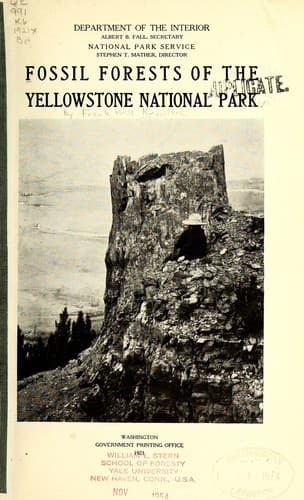
Fossil Forests of the Yellowstone National Park
Knowlton, Frank Hall
Paleobotany -- Yellowstone National Park; Petrified forests; Trees, Fossil -- Yellowstone National Park
feet—Hot springs—Mud geysers.
Mount McKinley South 2,645 Highest mountain in North
1917 central America—Rises higher above
Alaska. surrounding country than any
other mountain in the world.
Grand Canyon North 1,009 The greatest example of erosion
1919 central and the most sublime spectacle
Arizona. in the world.
Lafayette Maine coast. 12 The group of granite mountains
1919 upon Mount Desert Island.
Zion Southwestern 120 Magnificent gorge (Zion
1919 Utah. Canyon), depth from 1,500 to
2,500 feet, with precipitous
walls—Of great beauty and
scenic interest.
THE FOSSIL FORESTS OF THE YELLOWSTONE NATIONAL PARK.
By F. H. Knowlton,
_United States Geological Survey._
INTRODUCTION.
Isolated pieces of fossil wood are of comparatively common and
widespread occurrence, especially in the more recent geological deposits
of the West. Not infrequently scattered logs, stumps, and roots of
petrified or lignitized trees are brought to light, but only
exceptionally are they so massed and aggregated as to be worthy of the
designation of fossil forests. Examples of such are the celebrated
fossil forests of relatively late geological age near Cairo, Egypt, the
huge prostrate trunks in the Napa Valley near Calistoga, Cal., and the
geologically much older and far more extensive forests now widely known
as the Petrified Forest National Monument in Apache County, Ariz. But in
many respects the most remarkable fossil forests known are those now to
be described in the Yellowstone National Park. In the forests first
mentioned the trunks and logs were all prostrated before fossilization,
and it is perhaps not quite correct to designate such aggregations as
veritable fossil forests, though they usually are so called. In the
fossil forests of Arizona, for example, which are scattered over many
square miles of what is now almost desert, all the trunks show evidence
of having been transported from a distance before they were turned to
stone. Most of them are not even in the position in which they were
originally entombed, but have been eroded from slightly higher horizons
and have rolled in the greatest profusion to lower levels. As one views
these Arizona forests from a little distance, with their hundreds, even
thousands, of segments of logs, it is difficult to realize that they are
really turned to stone and are now exhumed from the earth. The
appearance they present (see fig. 1) is not unlike a “log drive” that
Public-domain text, read in full here on John Shaqi.
Reviews
Reviews
No reviews yet
Be the first to share your thoughts on this work.
Join the Discussion
Join the discussion
Sign in to leave a comment or review.
Sign InorCreate an account