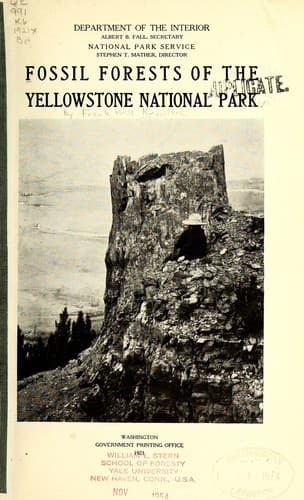
Fossil Forests of the Yellowstone National ParkKnowlton, Frank Hall
Science
Fossil Forests of the Yellowstone National Park
Knowlton, Frank Hall
Paleobotany -- Yellowstone National Park; Petrified forests; Trees, Fossil -- Yellowstone National Park
has been stranded by the receding waters and left until the bark had
disappeared and many logs had fallen into partial decay. Trunks of many
sizes and lengths are now mingled and scattered about in the wildest
profusion, and the surface of the ground is carpeted with fragments of
wood that have been splintered and broken from them. In the Yellowstone
National Park, however, most of the trees were entombed in the upright
position in which they grew, by the outpouring of various volcanic
materials, and as the softer rock surrounding them is gradually worn
away they are left standing erect on the steep hillsides, just as they
stood when they were living: in fact, it is difficult at a little
distance to distinguish some of these fossil trunks from the
lichen-covered stumps of kindred living species. Such an aggregation of
fossil trunks is therefore well entitled to be called a true fossil
forest. It should not be supposed, however, that these trees still
retain their limbs and smaller branches, for the mass of volcanic
material falling on them stripped them down to bare, upright trunks.
[Illustration: Fig. 1.—Fossil Logs in Petrified Forest National
Monument, Apache County, Arizona.]
[Illustration: Fig. 2.—Upright fossil trunk in Gallatin Mountains,
Montana.
Courtesy of E. C. Alderson.]
The fossil forests of the Yellowstone National Park cover an extensive
area in the northern portion of the park, being especially abundant
along the west side of Lamar River for about 20 miles above its junction
with the Yellowstone. Here the land rises rather abruptly to a height of
approximately 2,000 feet above the valley floor. It is known locally as
Specimen Ridge, and forms an approach to Amethyst Mountain. There is
also a small fossil forest containing a number of standing trunks near
Tower Falls, and near the eastern border of the park along Lamar River
in the vicinity of Cache, Calfee, and Miller Creeks, there are many more
or less isolated trunks and stumps of fossil trees, but so far as known
none of these are equal in interest to the fossil forest on the slopes
of Specimen Ridge.
[Illustration: Fig. 3.—Upright trunk and “hoodoo” in Gallatin
Mountains, Montana.
Courtesy of E. C. Alderson.]
The fossil forests are reached over a road from the Mammoth Hot Springs,
or from Camp Roosevelt near Tower Falls, and they are in their way quite
as wonderful and worthy of attention as many of the other features for
which the Yellowstone National Park is so justly celebrated.
Public-domain text, read in full here on John Shaqi.
Reviews
Reviews
No reviews yet
Be the first to share your thoughts on this work.
Join the Discussion
Join the discussion
Sign in to leave a comment or review.
Sign InorCreate an account