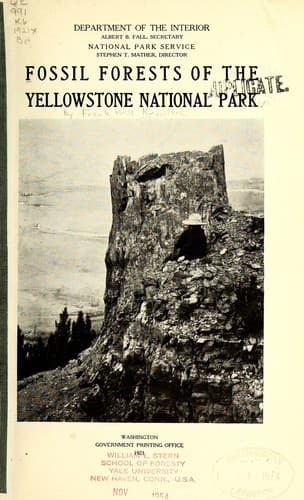
Fossil Forests of the Yellowstone National ParkKnowlton, Frank Hall
Science
Fossil Forests of the Yellowstone National Park
Knowlton, Frank Hall
Paleobotany -- Yellowstone National Park; Petrified forests; Trees, Fossil -- Yellowstone National Park
Mr. Arnold Hague gives the following graphic account of this and
adjacent areas:
From one end to the other the Absarokas present a high, imposing
plateau, with elevations ranging from 10,000 to over 12,000 feet above
sea level. The entire mass is made up almost exclusively of Tertiary
igneous rocks. * * * Degradation of the mass has taken place on a
grand scale. Vast quantities of volcanic ejectmenta have been removed
from the summit, but no reliable data exist by which the amount can be
estimated even approximately. All the higher portions have been
sculptured by glacial ice. Enormous amphitheaters have been carved out
of the loose agglomerates, and peaks, pinnacles, and relics of great
table-lands testify in some measure to the forces of erosion. The
plateau is scored by a complete network of deep valleys and gorges,
which dissect it in every direction, and lay bare the structure of the
vast volcanic pile.[1]
Within the park there is evidence of similar volcanic activity, and it
is clear that the basin between the encircling ranges was filled to its
present elevation by volcanic flows, which formed the present park
plateau. The area within which the fossil forests are now found was
apparently in the beginning an irregular but relatively flat basin, on
the floor of which after a time there grew the first forest. Then there
came from some of the volcanoes, probably those to the north, an
outpouring of ashes, mud flows, and other material which entirely buried
the forest, but so gradually that the trees were simply submerged by the
incoming material, few of them being prostrated. On the raised floor of
the basin, after a time, the next forest came into existence, only to be
in turn engulfed as the first had been, and so on through the period
represented by the 2,000 feet or more of similar beds. The series of
entombed forests affords a means of making at least a rough estimate of
the time required for the upbuilding of what is now Specimen Ridge and
its extensions. (See p. 27.)
During the time this 2,000 feet of material was being accumulated, and
since then to the present day, there has been relatively little warping
of the earth’s crust at this point; that is, the beds were then, and
still are, practically horizontal, so that the fossil forests, as they
are being gradually uncovered, still stand upright.
When the volcanic activities had finally ceased, the ever-working
disintegrating forces of nature began to tear and wear down this
accumulated material, eroding the beds on a grand scale. Deep canyons
and gulches have been trenched, and vast quantities of the softer
materials have been carried away by the streams and again deposited on
lower levels or transported to great and unknown distances.
Public-domain text, read in full here on John Shaqi.
Reviews
Reviews
No reviews yet
Be the first to share your thoughts on this work.
Join the Discussion
Join the discussion
Sign in to leave a comment or review.
Sign InorCreate an account