Fossil Forests of the Yellowstone National ParkKnowlton, Frank Hall
Science
Fossil Forests of the Yellowstone National Park
Knowlton, Frank Hall
Paleobotany -- Yellowstone National Park; Petrified forests; Trees, Fossil -- Yellowstone National Park
As the material in which the fossil forests are now entombed consist of
ashes, mud flows, breccia, and the like, not all the beds are of the
same texture end hardness, so that erosion has acted unevenly on them
and has produced many peculiar rock forms. The grotesque so-called
“hoodoos” have been carved out in this manner. The fossil trunks, being
usually harder than the surrounding matrix in which they are embedded,
have more firmly resisted erosion and now project to different heights
above the general level. In exposed beds that are nearly or quite
horizontal, disintegration has acted at nearly equal pace on the trunks
and on the matrix, so that the trunks are nearly or quite on a level
with the surrounding surface. On steep hillsides, however, from which
all loose material is easily and quickly removed, some of the fossil
trunks stand up to a height of 20 or 30 feet. If the beds had been
tilted at a considerable angle, these trunks could project from the
surface for only a short distance before their weight would break them
off, showing again the remarkably stable conditions that have continued
since the trunks were covered up.
AMETHYST MOUNTAIN.
The fossil forest that was first brought to scientific attention is on
the northern slope of Amethyst Mountain, opposite the mouth of Soda
Butte Creek, 12 miles southeast of Camp Roosevelt. The following
account, by Dr. William H. Holmes, the discoverer of these fossil
forests, shows the impression first made by them:
As we ride up the trail that meanders the smooth river bottom [Lamar
River] we have but to turn our attention to the cliffs on the right
hand to discover a multitude of the bleached trunks of the ancient
forests. In the steeper middle portion of the mountain face, rows of
upright trunks stand out on the ledges like the columns of a ruined
temple. On the more gentle slopes farther down, but where it is still
too steep to support vegetation, save a few pines, the petrified
trunks fairly cover the surface, and were at first supposed by us to
be shattered remains of a recent forest.[2]
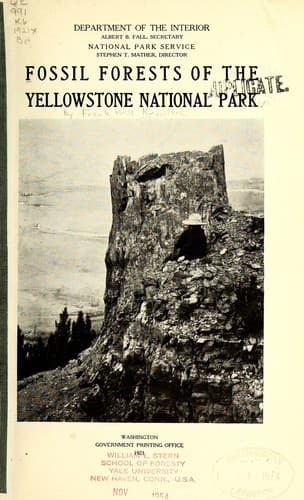
These trunks may easily be seen from the road along the Lamar River,
about a mile away. They stand upright—as Holmes has said, like the
pillars of some ruined temple—and a closer view shows that there is a
succession of these forests, one above another. In the foothills and
several hundred feet above the valley there is a perpendicular wall of
volcanic breccia, which in some places attains a height of nearly 100
feet. The fossil trunks may be seen in this wall in many places, all of
them standing upright, in the position in which they grew. Some of these
trunks, which are 2 to 4 feet in diameter and 20 to 40 feet high, are so
far weathered out of the rock as to appear just ready to fall: others
are only slightly exposed: niches mark the places from which others have
already fallen: and the foot of the cliff is piled high with fragments
of various sizes.
Public-domain text, read in full here on John Shaqi.
Reviews
Reviews
No reviews yet
Be the first to share your thoughts on this work.
Join the Discussion
Join the discussion
Sign in to leave a comment or review.
Sign InorCreate an account