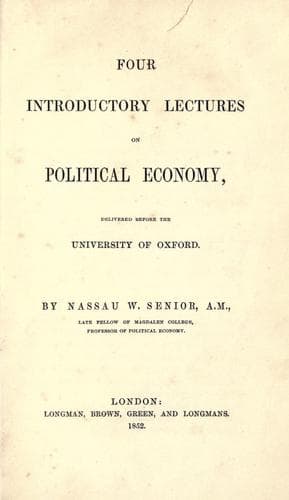
Four Introductory Lectures on Political EconomySenior, Nassau William
General
Four Introductory Lectures on Political Economy
Senior, Nassau William
Economics
In the present and the following two Lectures, I shall consider whether
Political Economy is a physical or a mental study; whether it may be
more conveniently treated as a science or as an art; and whether its
premises are to be taken solely from observation and consciousness,
or rest, in part, on arbitrary assumptions. And I shall begin by
stating, at some length, the distinction between science and art,--not
with the hope of saying anything new, but because I believe that that
distinction, though it has been clearly drawn, may not be familiar to
all my hearers.
Shortly, it may be said that, as a history is a statement of past
facts, so a science is a statement of existing facts, and an art
a statement of the means by which future facts may be caused or
influenced, or, in other words, future events brought about. The first
two aim only at supplying materials for the memory and the judgment;
they do not presuppose any purpose beyond the acquisition of knowledge.
The third is intended to influence the will. It presupposes that some
object is to be attained, and points out the easiest, the safest, or
the most effectual conduct for that purpose. It is for this reason
that the collection of related facts which constitute a science is
generally a less complex thing than the collection of related precepts
which constitute an art. A single science may be complete in itself;--a
man may confine himself to chemistry, or to zoology, or to botany. He
may pursue any one of those sciences to the boundaries of existing
knowledge, and know nothing of the others. But an art must draw its
materials from many sciences. No man can teach or practise well the
art of agriculture unless he have some knowledge of chemistry, botany,
zoology, mechanics, and indeed of many other sciences.
Public-domain text, read in full here on John Shaqi.
Reviews
Reviews
No reviews yet
Be the first to share your thoughts on this work.
Join the Discussion
Join the discussion
Sign in to leave a comment or review.
Sign InorCreate an account