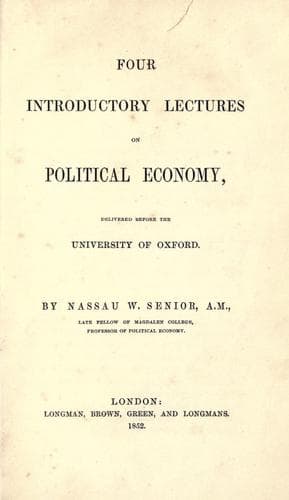
Four Introductory Lectures on Political EconomySenior, Nassau William
General
Four Introductory Lectures on Political Economy
Senior, Nassau William
Economics
In the progress of human knowledge art precedes science. The first
efforts of man are practical. He has an object in view, and tries
various means of accomplishing it. Some of these utterly fail, some
succeed imperfectly, and others are effectual, but at an unnecessary
expense of time and trouble. As his experience increases, he gradually
lays down for himself certain practical rules. If the business in which
he is engaged can be managed by a solitary individual, these rules may
be known only to himself, and be lost at his death. It is thus that we
have lost many of the secrets of the ancient painters. But if it be one
that requires co-operation, they become known to his assistants and to
his pupils, and gradually to all who are engaged in similar pursuits.
Many minds are employed in improving them and in adding to their
number, until at length they swell into a system. It may be long,
however, before they exist in any but a traditional form. The great
architects of the middle ages left behind them no written precepts.
They taught their pupils by oral instruction, and the rest of the world
and posterity by example. The desire, however, to communicate and
perpetuate information is one of the strongest passions of inventive
minds. As books multiply and become the principal means by which this
can be effected, those who are conscious of superior knowledge become
writers. They compose treatises in which the means which are supposed
to be productive of certain effects are arranged and preserved; and
the knowledge which previously rested on individual experience or
traditional routine becomes an art.
Public-domain text, read in full here on John Shaqi.
Reviews
Reviews
No reviews yet
Be the first to share your thoughts on this work.
Join the Discussion
Join the discussion
Sign in to leave a comment or review.
Sign InorCreate an account