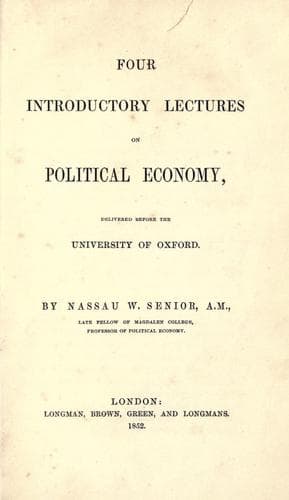
Four Introductory Lectures on Political EconomySenior, Nassau William
General
Four Introductory Lectures on Political Economy
Senior, Nassau William
Economics
Where the subject is matter the distinction between an art and a
science is in general easily perceptible. No one confounds the science
of projectiles with the art of gunnery, or the art of surgery with the
science of anatomy. But it appears to be much less easy to distinguish
the arts and the sciences which have for their subject the operations
of the human mind. Thus we often talk of the art of logic, and of
the science of morality. But logic is not an art but a science. It
is not a collection of precepts how to reason, but a statement of
the principles on which all reasoning depends. The logician does not
advise, he merely instructs. He does not teach us to argue by means
of syllogisms, but asserts the fact that all reasoning is syllogistic.
His statements are all general; they have no relation to time or to
place. They are unconnected with any science but his own. On the
other hand, morality is not a science but an art. The object of the
moralist is not to inform us as to the nature of the faculties and the
sensations of man, but to advise us how to use those faculties, and how
to subject ourselves to those sensations, for the purpose of promoting
our happiness. He must therefore draw his materials from many different
sciences, and must vary his precepts according to the social condition
of those whom he addresses. The morality of the Stoics was fitted to
an aggregate of petty communities constantly engaged in foreign and
civil war, in which defeat involved the worst of human evils, the loss
of life, of relations, of property, and of liberty. No Greek could
be sure that in a year’s time his country might not be conquered by
a neighbouring tribe, or his party overthrown by a revolution, and
all his family and friends murdered before his eyes, or sold with him
into slavery. Under such circumstances, insensibility, the power of
enduring the approach and the presence of evil, and the insecurity, and
even the absence of good, appeared to be the quality most conducive
to happiness. The Stoic moralist, therefore, was as anxious to blunt
the desires and harden the perceptions of his pupils, as the English
moralist is to rouse their ambition, and to expand their sensibility.
The logic of Aristotle and the logic of Whately are the same, but how
little do we find in common when we compare the morality of Zeno with
that of Smith or of Paley.
Public-domain text, read in full here on John Shaqi.
Reviews
Reviews
No reviews yet
Be the first to share your thoughts on this work.
Join the Discussion
Join the discussion
Sign in to leave a comment or review.
Sign InorCreate an account