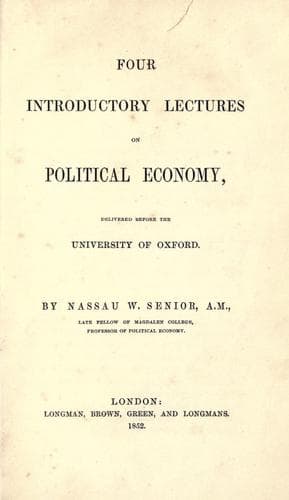
Four Introductory Lectures on Political Economy — John Shaqi
Four Introductory Lectures on Political EconomySenior, Nassau William
General
Four Introductory Lectures on Political Economy
Senior, Nassau William
Economics
Sciences are divided into two great classes, differing both as to the
matters which they treat, and the sources from which they draw their
premises. These are the physical and the mental, or, as they are
sometimes called, the moral sciences. The proper subjects of the first
are the properties of matter; those of the second are the sensations,
faculties, and habits of the human mind. As we have no experience of
mind separated from matter (perhaps indeed are incapable of conceiving
its existence), and as the mind can act only through the body, even the
more purely mental sciences are forced to take notice of matter; and
many of them, such as the sciences which have been called æsthetic,
those which account for the pleasure which we derive from beauty and
sublimity, seem at first sight to treat of little except material
objects. But they consider those objects merely with reference to their
effects on the human mind. To classify and account for those effects as
a part of the philosophy of mind is the purpose of the science, and it
regards in matter only the qualities which produce them. On the other
hand, a botanist in the description of plants cannot omit the qualities
which render them agreeable or useful to man. Without doubt, to be
pleased by the sight and smell of a rose is as much an attribute of the
human mind as the form, colour, and other qualities which occasion
that pleasure are attributes of the rose. But it is to the rose only
that the botanist looks. He states that it is beautiful and odoriferous
as a part of the description of the plant, not of that of the being to
whom it is beautiful and odoriferous.
The same difference separates arts, though the line is less clearly
marked. For as every art must use material instruments, it is to a
certain extent physical; and as every art aims at producing pleasure
or preventing pain, it must be, to a certain extent, mental. Still,
however, the difference exists. No one would call rhetoric a physical
art, though its teacher must deliver precepts as to voice and gesture.
No one would call agriculture a mental art, though a treatise on
agriculture would be incomplete which did not compare the advantages
and disadvantages of task-work and day-work,--a comparison involving
wide and numerous moral considerations.
Public-domain text, read in full here on John Shaqi.
Reviews
Reviews
No reviews yet
Be the first to share your thoughts on this work.
Join the Discussion
Join the discussion
Sign in to leave a comment or review.
Sign InorCreate an account