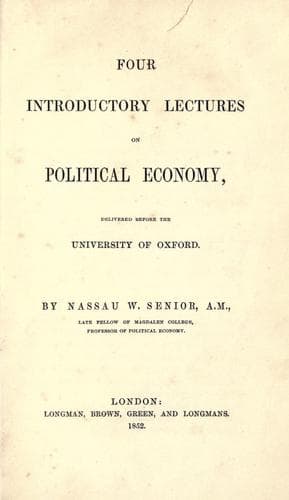
Four Introductory Lectures on Political Economy — John Shaqi
Four Introductory Lectures on Political EconomySenior, Nassau William
General
Four Introductory Lectures on Political Economy
Senior, Nassau William
Economics
In all sciences and in all arts these sources are but three--observation,
consciousness, and hypothesis. The physical sciences, being only
secondarily conversant with mind, draw their premises almost exclusively
from observation or hypothesis. Those which treat only of magnitude and
number, or, as they are usually called, the pure sciences, draw them
altogether from hypothesis. The mathematician does not measure the radii
of a circle in order to ascertain that they are all equal: he infers
their equality from the definition with which he sets out. Those which
abstain from hypothesis depend on observation. It is by observation that
the astronomer ascertains the motions of the planets, the botanist
classifies plants, and the chemist discovers the affinities of different
bodies. They disregard almost entirely the phenomena of consciousness.
The physical _arts_ are almost exclusively based on observation. As
their object is to produce positive effects, they trust as little as
possible to hypothesis; and the mental phenomena which they have to
consider are generally few and simple. The art of navigation, the art of
mining, or the art of fortification, might be taught by a man who had
never studied seriously the operations of his own mind.
On the other hand, the mental sciences and the mental arts draw their
premises principally from consciousness. The subjects with which they
are chiefly conversant are the workings of the human mind. And the only
mind whose workings a man really knows is his own. When he wishes to
ascertain the thoughts and the feelings of others, his first impulse
always is, to endeavour to suppose himself in what he believes to be
their situation, and to consider how he himself would then think and
feel. His next impulse is to infer that similar moral and intellectual
processes are taking place in them. If he be a cautious observer, he
endeavours to correct this inference by examining their countenances,
their words, and their actions. But these are uncertain symptoms, often
occasioned by a state of mind different from that which they appear
to indicate; and often employed for the purpose of concealment or of
deception.
Public-domain text, read in full here on John Shaqi.
Reviews
Reviews
No reviews yet
Be the first to share your thoughts on this work.
Join the Discussion
Join the discussion
Sign in to leave a comment or review.
Sign InorCreate an account