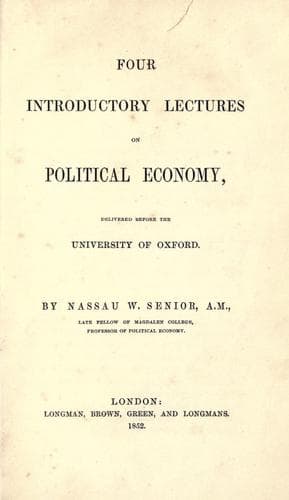
Four Introductory Lectures on Political EconomySenior, Nassau William
General
Four Introductory Lectures on Political Economy
Senior, Nassau William
Economics
When a man endeavours to discover what is passing in the mind of
another, by reflecting on what has passed or is passing in his own,
the certainty of the result depends of course on the degree in which
the two minds coincide. The educated man, therefore, estimates ill the
feelings and the faculties of the uneducated, the adult those of the
child, the sane those of the insane, the civilised man those of the
savage. And this accounts for the constant mismanagement of the lower
orders, and of children, madmen, and savages, by their intellectual and
moral superiors. The student of mental science is in the situation of
an anatomist, allowed to dissect only a single subject, and forced to
conjecture the internal conformation of other men by assuming that it
resembles that of the subject which he has dissected, and correcting
that assumption only by observing the forms of their bones and the
outward play of their muscles. The mental peculiarities of other men
are likely to mislead him in particular instances. His own mental
peculiarities are likely to mislead him on all occasions.
Another important difference, between mental and physical studies, is
the degree and the manner in which they respectively can be aided by
experiment. When we are dealing with matter, we frequently are able
to combine its particles at will, and to ascertain the results of the
combination. If we find that, all other things remaining the same, the
presence or absence of a given element is followed by the presence
or absence of a given result, we ascribe to that element and to that
result the relation of cause and effect, or at least of condition and
result.
But we can scarcely be said to be able to make experiments on the minds
of others. It is necessary to an experiment, that the observer should
know accurately the state of the thing observed before the experiment,
and its state immediately after it. But when the minds of other men
are the subject, we can know but little of either the one state or of
the other. We are forced, therefore, to rely not on experiment, but
on experience, that is to say, not on combinations of known elements
effected for the purpose of testing the result of each different
combination, but on our observation of actual occurrences, the results
of the combination of numerous elements, only a few of which are within
our own knowledge. And the consequence is, that we frequently connect
facts which are really independent of one another, and not unfrequently
mistake obstacles for causes.
Public-domain text, read in full here on John Shaqi.
Reviews
Reviews
No reviews yet
Be the first to share your thoughts on this work.
Join the Discussion
Join the discussion
Sign in to leave a comment or review.
Sign InorCreate an account