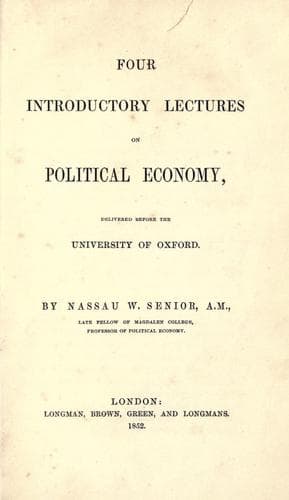
Four Introductory Lectures on Political EconomySenior, Nassau William
General
Four Introductory Lectures on Political Economy
Senior, Nassau William
Economics
From the appearance of the “Wealth of Nations,” Political Economy has
excited a constantly increasing interest. All the events, fortunate and
unfortunate, which have occurred in Europe during that extraordinary
period, have tended both to increase its actual importance, and to
occasion that importance to be better estimated. The art to which
it is principally applicable is the great art of government, and
particularly that branch of government which consists in the raising
and employment of public money. Not a tax can be imposed or applied
without materially affecting the fortunes of those by whom it is
paid, of those among whom it is expended, and of third persons, many
of whom, perhaps, are unaware of its existence. To ascertain the
character and the extent of these effects, even as to any existing
tax, without the aid of the general principles supplied by Political
Economy, is scarcely practicable: to foretell or even to conjecture,
with probability, the effects of an untried tax, without such aid,
is impossible. A government ignorant of the nature of wealth, or of
the laws which regulate its production and distribution, resembles a
surgeon who has not studied anatomy, or a judge unacquainted with law.
But, under the old system of Continental Europe, many things concurred
to diminish the attention which the evil consequences of this ignorance
might have been expected to attract. Each monarchy was considered the
patrimony of its king, and its public revenue a portion of his income.
All that he could get he spent or gave away; part of it went in wars
for his honour, part was wasted in building and pageantry, and part
was distributed among his courtiers. Public debts were few and small,
and were the debts, not of the nation, but of the crown. The interest
was not an additional burden on the people, but a deduction from the
gratifications of the prince, and was reduced from time to time,
either by depreciating the currency, or by the simple expedient of a
refusal to pay. No right was recognised in the public to inquire into
the amount of the royal revenue, the sources from which it was derived,
or the purposes to which it was applied. These were the private affairs
of the sovereign, which it was not decent or even safe to canvass.
All this was changed at once by the French Revolution. It was proclaimed
in France, and admitted, or scarcely denied, on the rest of the
Continent, that governments are made for nations, not nations for
governments; and that the public revenue is the revenue, not of the
government, but of the nation,--not a property, but a trust,--not a rent
or a tribute, but the purchase-money of the labour necessary to prevent
foreign and domestic violence and fraud, paid over to the government
merely as an administrator, unlawfully employed if applied to any other
purpose, and unlawfully demanded if more than necessary for that
purpose.
Public-domain text, read in full here on John Shaqi.
Reviews
Reviews
No reviews yet
Be the first to share your thoughts on this work.
Join the Discussion
Join the discussion
Sign in to leave a comment or review.
Sign InorCreate an account