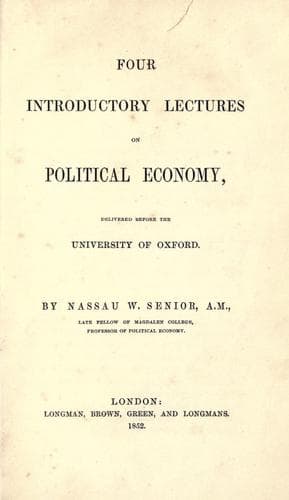
Four Introductory Lectures on Political EconomySenior, Nassau William
General
Four Introductory Lectures on Political Economy
Senior, Nassau William
Economics
Every man felt himself interested that the proportion of his income
which he had to pay over to the state should be reduced, either by
diminishing expenditure, or by varying the mode of assessment.
At the same time the wars in which Europe was involved for a quarter
of a century, and the scale on which they were carried on, occasioned
in almost every country an enormous increase of that proportion of the
whole income of the people which is administered by the government.
Almost every country created a national debt, and thus threw on its
rulers the additional duty of collecting a revenue, to be applied, not
for current expenses, but to repay those who had advanced the public
expenditure of previous years. And not only were the people induced to
interest themselves in public affairs, they were frequently called upon
to act. In many countries the whole form of government was more than
once demolished and reconstructed. Almost every nation, at some period,
received, or was promised, representative institutions; everywhere the
monarch, by appealing to the people, recognised the existence and the
force of a national will.
In the British Islands self-government was no novelty, but many
circumstances concurred to increase and diffuse the interest taken in
public affairs. Among these circumstances the principal ones were the
extension of the public expenditure, the alterations in the currency,
and the effects of the poor laws. In no extensive empire recorded in
history, has so large a portion of the annual produce of the land,
labour, and capital of the people, been administered by the state.
Every man felt himself to be a public debtor, and almost every man
became, in some shape or other, a public creditor. At the same time
the nominal value of money, the standard by which his claims and
liabilities were measured, was subject to variations considerable in
themselves, grossly exaggerated by one party, and absolutely denied by
another, of which few could point out the immediate causes, and no one
could foretell the probable extent. Meanwhile, the effects of the poor
laws over the southern and south-eastern districts of England, became
every day more apparent. It became obvious to the most unreflecting,
that they were gradually altering the rights, both of property and of
industry, the relations between the poor and the rich, the labourer and
his employer, and the habits and feelings of the agricultural, and in
many places of the town population.
All these causes, and many others which it would be tedious and almost
impossible to enumerate, have given to the political sciences, during
the last sixty years, an interest which no study, except perhaps that
of theology during the early progress of the Reformation, ever acquired.
And this at a period when the extension of books and newspapers, and of
the habits and means of discussion and communication, has been such as
our most sanguine ancestors never anticipated.
Public-domain text, read in full here on John Shaqi.
Reviews
Reviews
No reviews yet
Be the first to share your thoughts on this work.
Join the Discussion
Join the discussion
Sign in to leave a comment or review.
Sign InorCreate an account