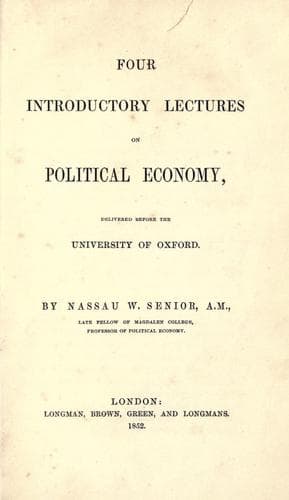
Four Introductory Lectures on Political EconomySenior, Nassau William
General
Four Introductory Lectures on Political Economy
Senior, Nassau William
Economics
But though I follow substantially the example of Turgot and Ricardo,
I do not propose to follow it implicitly. Though I profess to teach
only the theory of wealth, I do not refuse the right to consider
its practical application. There is, indeed, something imposing and
almost seductive in a work of pure science, especially if it be a
science connected with human affairs. We admire the impartiality of
the philosopher who discusses matters that agitate nations without
mixing in the strife, or noticing the use that may be made of the
truths which he scatters. And we admit, with comparative readiness,
conclusions which do not appear to have been influenced by passion, the
great disturber of observation and of reasoning. This was one of the
great causes of the popularity of Ricardo. He was the first English
writer who produced Political Economy in a purely scientific form. He
is usually a logical reasoner, so that his conclusions can seldom be
denied if his premises are conceded, and his premises must usually be
conceded, for they are usually hypothetical. Men were delighted to find
what appeared to be firm footing, in a new and apparently unstable
science, and readily gave their assent to theories which did not
obviously lead to practice. But though it be desirable that from time
to time a writer should arise able and willing to treat the science in
this severe and abstract manner, his treatise will be more serviceable
to masters than to students. To those who are already familiar with the
subject, to those who have already perceived how deeply mankind are
interested in obtaining correct views as to the laws which regulate the
production and distribution of wealth, a naked statement of those laws,
though it should not possess the elegance of Turgot, or the originality
of Ricardo, must still be useful, and even agreeable. A mere student
would find it repulsive. He ought to be attracted to Political Economy
by seeing from time to time its practical application. He should be
taught that he is studying a science composed of principles which no
statesman, no legislator, no magistrate, no member even of a board
of guardians can safely disregard. And this will be best effected
by putting before him examples of the good which has been done by
adhering to those principles, and of the evil which has punished their
neglect. These examples, therefore, I shall think myself at liberty
to give. I shall think myself justified, for instance, in showing how
the natural distribution of wealth may be affected by the institution
of poor-laws. And I shall not confine myself to their effects upon
wealth. I shall consider how far a well-framed poor-law may promote the
moral as well as the material welfare of the labouring classes, and an
ill-administered poor-law may produce moral, intellectual, and physical
degradation. But these discussions must be considered as episodes. They
form no part of the science which I profess. I shall enter into them,
Public-domain text, read in full here on John Shaqi.
Reviews
Reviews
No reviews yet
Be the first to share your thoughts on this work.
Join the Discussion
Join the discussion
Sign in to leave a comment or review.
Sign InorCreate an account