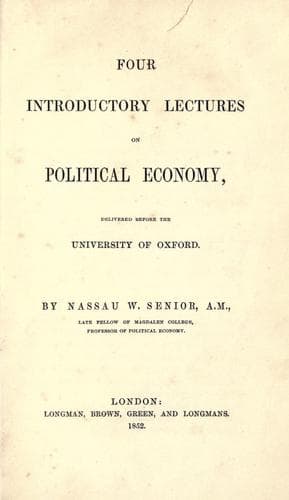
Four Introductory Lectures on Political EconomySenior, Nassau William
General
Four Introductory Lectures on Political Economy
Senior, Nassau William
Economics
There is one science, however, to which this treatment cannot as yet be
applied, and it is the science most intimately connected with the art
of Political Economy, that is to say, the science which states the laws
regulating the production, accumulation, and distribution of wealth,
or, in other words, the science (as distinguished from the art) of
Political Economy itself. The time I trust will come, perhaps within
the lives of some of us, when the outline of this science will be
clearly made out and generally recognised, when its nomenclature will
be fixed, and its principles form a part of elementary instruction.
A teacher of the art of Political Economy will then be able to refer
to the principles of the science as familiar and admitted truths. I
scarcely need repeat how far this is from being the case at present.
Without doubt, many of the laws of the science have been discovered,
and a few of them are generally acknowledged; and some of its terms
have been defined, and the definitions accepted. Still, however,
there remains, as I remarked in the first Lecture, much to explore
and much to explain. We are still far from the bounds of what is to
be known, and further still from any general agreement as to what is
known. Every writer, therefore, on the art of Political Economy, is
forced to prefix, or to interweave among his precepts, his own views
of the science, and thus to add to the practical portion of his work a
scientific portion of perhaps equal length. It appears to me, that the
five years during which this professorship is tenable, is too short a
period for so vast an undertaking. I propose, therefore, to take as my
subject, not the art, but the much narrower province, the science; and
to explain, in the following Lectures, the general laws which regulate
the production, accumulation, and distribution of wealth, leaving it to
writers with more leisure to point out what are the institutions most
favourable to its production and accumulation, and to speculators of
still wider views to say what production, accumulation, distribution,
and consumption are most favourable to human happiness.
Public-domain text, read in full here on John Shaqi.
Reviews
Reviews
No reviews yet
Be the first to share your thoughts on this work.
Join the Discussion
Join the discussion
Sign in to leave a comment or review.
Sign InorCreate an account