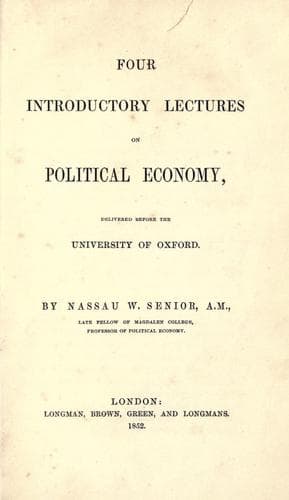
Four Introductory Lectures on Political Economy — John Shaqi
Four Introductory Lectures on Political EconomySenior, Nassau William
General
Four Introductory Lectures on Political Economy
Senior, Nassau William
Economics
to facilitate the distribution. All these operations, though many of
them are really the result of a plurality of motives, are considered
by Political Economy as flowing solely from the desire of wealth.
The science then proceeds to investigate the laws which govern these
several operations, under the supposition that man is a being who
is determined, by the necessity of his nature, to prefer a greater
proportion of wealth to a smaller in all cases, without any other
exception than that constituted by the two counter-motives already
specified. Not that any political economist was ever so absurd as to
suppose that mankind are really thus constituted, but because this is
the mode in which science must necessarily proceed. When an effect
depends upon a concurrence of causes, those causes must be studied one
at a time, and their laws separately investigated, if we wish, through
the causes, to obtain the power of either predicting or controlling the
effect; since the law of the effect is compounded of the laws of all
the causes which determine it. The law of the centripetal and that of
the tangential force must have been known, before the motions of the
earth and planets could be explained, or many of them predicted. The
same is the case with the conduct of man in society. In order to judge
how he will act under the variety of desires and aversions which are
concurrently operating upon him, we must know how he would act under
the exclusive influence of each one in particular. There is, perhaps,
no action of a man’s life in which he is neither under the immediate
nor under the remote influence of any impulse but the mere desire of
wealth. With respect to those parts of human conduct of which wealth
is not even the principal object, to these Political Economy does not
pretend that its conclusions are applicable. But there are also certain
departments of human affairs, in which the acquisition of wealth is the
main and acknowledged end. It is only of these that Political Economy
takes notice. The manner in which it necessarily proceeds is that of
treating the main and acknowledged end as if it were the sole end;
which, of all hypotheses equally simple, is the nearest to the truth.
The political economist inquires, what are the actions which would be
produced by this desire, if, within the departments in question, it
were unimpeded by any other?
[D] Essays on some Unsettled Questions of Political Economy,
pp. 137, 138, 139, 140, 144, 145.
Public-domain text, read in full here on John Shaqi.
Reviews
Reviews
No reviews yet
Be the first to share your thoughts on this work.
Join the Discussion
Join the discussion
Sign in to leave a comment or review.
Sign InorCreate an account