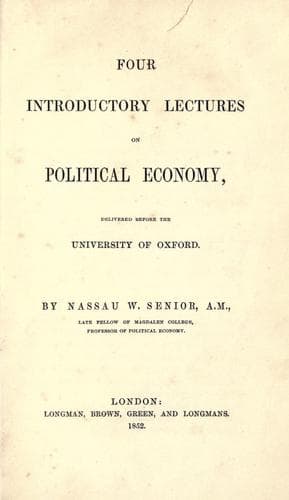
Four Introductory Lectures on Political EconomySenior, Nassau William
General
Four Introductory Lectures on Political Economy
Senior, Nassau William
Economics
“It reasons, and, as we contend, must necessarily reason, from
assumptions, not from facts. It is built upon hypotheses strictly
analogous to those which, under the name of definitions, are the
foundation of the other abstract sciences. Geometry presupposes
an arbitrary definition of a line, ‘that which has length but not
breadth.’ Just in the same manner does Political Economy presuppose an
arbitrary definition of man, as a being who invariably does that by
which he may obtain the greatest amount of necessaries, conveniences,
and luxuries, with the smallest quantity of labour and physical
self-denial with which they can be obtained in the existing state of
knowledge. It is true that this definition of man is not formally
prefixed to any work on Political Economy, as the definition of a line
is prefixed to Euclid’s Elements; and in proportion as, by being
so prefixed, it would be less in danger of being forgotten, we may
see ground for regret that it is not done. It is proper that what
is assumed in every particular case, should once for all be brought
before the mind in its full extent, by being somewhere formally stated
as a general maxim. Now, no one who is conversant with systematic
treatises on Political Economy will question, that whenever a
political economist has shown that, by acting in a particular manner,
a labourer may obviously obtain higher wages, a capitalist larger
profits, or a landlord higher rent, he concludes, as a matter of
course, that they will certainly act in that manner. Political Economy,
therefore, reasons from assumed premises--from premises which might
be totally without foundation in fact, and which are not pretended to
be universally in accordance with it. The conclusions of Political
Economy, consequently, like those of geometry, are only true, as
the common phrase is, in the abstract; that is, they are only true
under certain suppositions, in which none but general causes--causes
common to the whole class of cases under consideration--are taken into
account.”
I have extracted this long passage because it is a clear statement
of an original view of the science of Political Economy,--a view so
plausible, indeed so philosophical, that I feel bound either to adopt
it, or to state fully my reasons for rejecting it. I am not aware of
any writer, except, perhaps, Mr. Merivale, who has expressed a formal
concurrence in Mr. Mill’s doctrine; but Mr. Ricardo has practically
assented to it.
His treatment of the science, indeed, is still more abstract than
that proposed by Mr. Mill. He adds to Mr. Mill’s hypothesis other
assumptions equally arbitrary; and he draws all his illustrations, not
from real life, but from hypothetical cases. Out of these materials
he has framed a theory, as to the distribution of wealth, possessing
almost mathematical precision.
Public-domain text, read in full here on John Shaqi.
Reviews
Reviews
No reviews yet
Be the first to share your thoughts on this work.
Join the Discussion
Join the discussion
Sign in to leave a comment or review.
Sign InorCreate an account