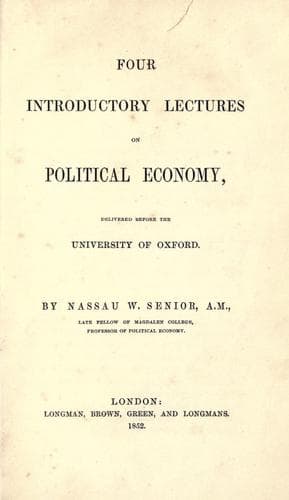
Four Introductory Lectures on Political Economy — John Shaqi
Four Introductory Lectures on Political EconomySenior, Nassau William
General
Four Introductory Lectures on Political Economy
Senior, Nassau William
Economics
This was a logical inference, and would consequently have been true
in fact, if the assumed premises had been true. The fact is, however,
that almost every one of them is false. It is not true that rent
depends on the difference in fertility of the different portions
of land in cultivation. It might exist if the whole territory of a
country were of uniform quality. It is not true that the labourer
always receives precisely the necessaries, or even what custom leads
him to consider the necessaries, of life. In civilised countries he
almost always receives much more; in barbarous countries he from time
to time obtains less. It is not true that as wealth and population
advance, agricultural labour becomes less and less proportionately
productive. The corn now raised with the greatest labour in England
is raised with less labour than that which was raised with the least
labour three hundred years ago, or than that which is now raised with
the least labour in Poland. It is not true that the share of the
produce taken by the capitalist is least in the richest countries.
Those are the countries in which it generally is the greatest. Mr.
Ricardo was certainly justified in assuming his premises, provided that
he was always aware, and always kept in mind, that they were merely
assumed. This, however, he seems sometimes not to know, and sometimes
he forgets. Thus he states, as an actual fact, that in an improving
country, the difficulty of obtaining raw produce constantly increases.
He states as a real fact, that a tax on wages falls not on the
labourer but on the capitalist.
He affirms that tithes occasion a proportionate increase in the price
of corn, and a proportionate increase of wages, and therefore are a tax
on the capitalist, not on the landlord. Positions both of which depend
on an assumed fixed amount of wages.
A third objection to reasoning on hypothesis is its liability to error,
either from illogical inference, or from the omission of some element
necessarily incident to the supposed case. When a writer takes his
premises from observation and consciousness, and infers from them what
he supposes to be real facts, if he have committed any grave error, it
generally leads him to some startling conclusion. He is thus warned
of the probable existence of an unfounded premise, or of an illogical
inference, and if he be wise, tries back until he has detected his
mistake. But the strangeness of the results of an hypothesis, gives
no warning. We expect them to differ from what we observe, and lose,
therefore, this incidental means of testing the correctness of our
reasoning.
Public-domain text, read in full here on John Shaqi.
Reviews
Reviews
No reviews yet
Be the first to share your thoughts on this work.
Join the Discussion
Join the discussion
Sign in to leave a comment or review.
Sign InorCreate an account