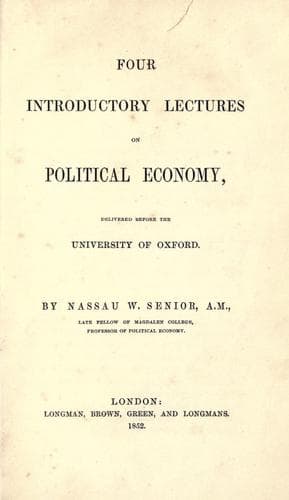
Four Introductory Lectures on Political EconomySenior, Nassau William
General
Four Introductory Lectures on Political Economy
Senior, Nassau William
Economics
But neither the reasoning of Mr. Mill, nor the example of Mr. Ricardo,
induce me to treat Political Economy as an hypothetical science. I
do not think it necessary, and, if unnecessary, I do not think it
desirable.
It appears to me, that if we substitute for Mr. Mill’s hypothesis,
that wealth and costly enjoyment are the _only_ objects of human desire,
the statement that they are universal and constant objects of desire,
that they are desired by all men and at all times, we shall have laid
an equally firm foundation for our subsequent reasonings, and have put
a truth in the place of an arbitrary assumption. We shall not, it is
true, from the fact that by acting in a particular manner a labourer
may obtain higher wages, a capitalist larger profits, or a landlord
higher rent, be able to infer the further fact that they will certainly
act in that manner, but we shall be able to infer that they will do
so in the absence of disturbing causes. And if we are able, as will
frequently be the case, to state the cases in which these causes may
be expected to exist, and the force with which they are likely to
operate, we shall have removed all objection to the positive as opposed
to the hypothetical treatment of the science.
I have said that the hypothetical treatment of the science, if
unnecessary, is undesirable. It appears to me to be open to three great
objections. In the first place it is obviously unattractive. No one
listens to an exposition of what might be the state of things under
given but unreal conditions, with the interest with which he hears a
statement of what is actually taking place.
In the second place, a writer who starts from arbitrarily assumed
premises, is in danger of forgetting, from time to time, their
unsubstantial foundation, and of arguing as if they were true. This
has been the source of much error in Ricardo. He assumed the land of
every country to be of different degrees of fertility, and rent to be
the value of the difference between the fertility of the best and of
the worst land in cultivation. The remainder of the produce he divided
into profit and wages. He assumed that wages naturally amount to
neither more nor less than the amount of commodities which nature or
habit has rendered necessary to maintain the labourer and his family
in health and strength. He assumed that, in the progress of population
and wealth, worse and worse soils are constantly resorted to, and that
agricultural labour, therefore, becomes less and less proportionately
productive; and he inferred that the share of the produce of land taken
by the landlord and by the labourer must constantly increase, and the
share taken by the capitalist constantly diminish.
Public-domain text, read in full here on John Shaqi.
Reviews
Reviews
No reviews yet
Be the first to share your thoughts on this work.
Join the Discussion
Join the discussion
Sign in to leave a comment or review.
Sign InorCreate an account