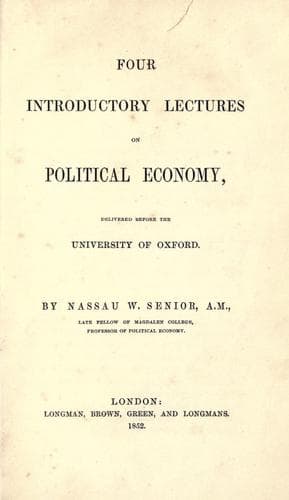
Four Introductory Lectures on Political Economy — John Shaqi
Four Introductory Lectures on Political EconomySenior, Nassau William
General
Four Introductory Lectures on Political Economy
Senior, Nassau William
Economics
In ordinary use, and I think it is the most convenient use, wealth
comprehends all those things, and those things only, which, directly
or indirectly, are made the subjects of purchase and sale, of letting
and hiring. For this purpose, they must, in the first place, possess
utility, or, in other words, be capable of affording pleasure or
preventing pain, since no one would purchase or hire anything
absolutely useless. In the second place, they must be limited in
supply, since no one would buy anything of which he might acquire as
much as he pleased by merely taking possession of it. The water in the
open sea is practically unlimited in supply; any one who chooses to go
for it, may have as much of it as he pleases. The portion of it which
has been brought to London to supply salt water baths is limited, and
cannot be obtained, therefore, without payment. In the third place,
nothing is wealth that is not capable of appropriation. Fine weather
is useful, and is limited in supply, but it is not wealth, since it
cannot be appropriated. Some things are capable of appropriation
only under peculiar circumstances. In an extensive, thinly inhabited
plain, light and air are incapable of appropriation, every inhabitant
may enjoy them equally; but in a town, one house intercepts them
from another. A town house, surrounded by an open space, has more
of them than one in a street. The possessor of such a house, and
of the ground which surrounds it, has practically appropriated its
peculiar advantages of light and air; they add to its value, and
form, therefore, part of his wealth. He even may sell them without
parting with his house, by selling the privilege of erecting buildings
which will intercept them. Fourthly, as is implied by the definition,
nothing can be wealth which is not directly or indirectly transferable.
High birth is agreeable and rare, it may add to the happiness of its
possessor, but, as it is absolutely incapable of transfer, it is not
part of his wealth. Most of our personal qualities are only indirectly
transferable; they are transferable, not in themselves, but embodied in
the commodities which their possessor can produce, or in the services
which he can render. The skill of a painter is transferable in the
form of a commodity, his pictures; the skill of a surgeon in that of
a service, the dexterity with which he performs an operation. Such
qualities perish by the death of the possessor, or may be impaired or
destroyed by disease, or rendered valueless by changes in the customs
of the country, which put an end to the demand for their products.
Even to the same person, and under the same circumstances in all other
respects, they may become wealth, or cease to be wealth, merely in
consequence of a change in the social position of their possessor. When
Miss Linley became Mrs. Sheridan, her powers of action and song ceased
to be wealth; they remained the delight of private societies, but were
no longer objects of sale.
Public-domain text, read in full here on John Shaqi.
Reviews
Reviews
No reviews yet
Be the first to share your thoughts on this work.
Join the Discussion
Join the discussion
Sign in to leave a comment or review.
Sign InorCreate an account