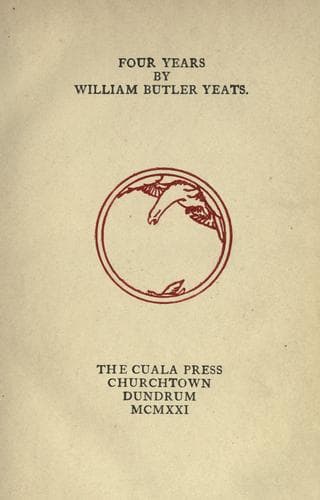
Poets, Irish -- 20th century -- Biography; Yeats, W. B. (William Butler), 1865-1939
I cannot remember who first brought me to the old stable beside
Kelmscott House, William Morris' house at Hammersmith, & to the
debates held there upon Sunday evenings by the socialist League. I
was soon of the little group who had supper with Morris
afterwards. I met at these suppers very constantly Walter Crane,
Emery Walker presently, in association with Cobden Sanderson, the
printer of many fine books, and less constantly Bernard Shaw and
Cockerell, now of the museum of Cambridge, and perhaps but once or
twice Hyndman the socialist and the anarchist Prince Krapotkin.
There too one always met certain more or less educated workmen,
rough of speech and manner, with a conviction to meet every turn.
I was told by one of them, on a night when I had done perhaps more
than my share of the talking, that I had talked more nonsense in
one evening than he had heard in the whole course of his past
life. I had merely preferred Parnell, then at the height of his
career, to Michael Davitt who had wrecked his Irish influence by
international politics. We sat round a long unpolished and
unpainted trestle table of new wood in a room where hung
Rossetti's 'Pomegranate,' a portrait of Mrs. Morris, and where one
wall and part of the ceiling were covered by a great Persian
carpet. Morris had said somewhere or other that carpets were meant
for people who took their shoes off when they entered a house, and
were most in place upon a tent floor. I was a little disappointed
in the house, for Morris was an old man content at last to gather
beautiful things rather than to arrange a beautiful house. I saw
the drawing-room once or twice and there alone all my sense of
decoration, founded upon the background of Rossetti's pictures,
was satisfied by a big cupboard painted with a scene from Chaucer
by Burne Jones, but even there were objects, perhaps a chair or a
little table, that seemed accidental, bought hurriedly perhaps,
and with little thought, to make wife or daughter comfortable. I
had read as a boy in books belonging to my father, the third
volume of 'The Earthly Paradise' and 'The Defence of Guinevere,'
which pleased me less, but had not opened either for a long time.
'The man who never laughed again' had seemed the most wonderful of
tales till my father had accused me of preferring Morris to Keats,
got angry about it and put me altogether out of countenance. He
had spoiled my pleasure, for now I questioned while I read and at
last ceased to read; nor had Morris written as yet those prose
romances that became, after his death, so great a joy that they
were the only books I was ever to read slowly that I might not
come too quickly to the end. It was now Morris himself that
stirred my interest, and I took to him first because of some
little tricks of speech and body that reminded me of my old
grandfather in Sligo, but soon discovered his spontaneity and joy
and made him my chief of men. To-day I do not set his poetry very
Public-domain text, read in full here on John Shaqi.
Reviews
Reviews
No reviews yet
Be the first to share your thoughts on this work.
Join the Discussion
Join the discussion
Sign in to leave a comment or review.
Sign InorCreate an account