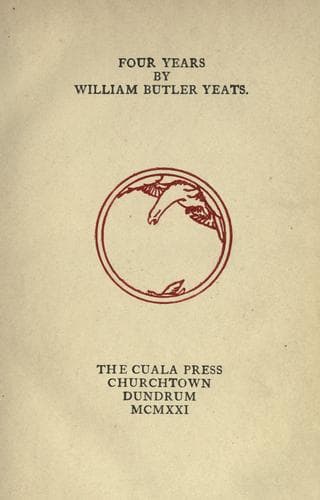
Poets, Irish -- 20th century -- Biography; Yeats, W. B. (William Butler), 1865-1939
high, but for an odd altogether wonderful line, or thought; and
yet, if some angel offered me the choice, I would choose to live
his life, poetry and all, rather than my own or any other man's. A
reproduction of his portrait by Watts hangs over my mantlepiece
with Henley's, and those of other friends. Its grave wide-open
eyes, like the eyes of some dreaming beast, remind me of the open
eyes of Titian's' Ariosto,' while the broad vigorous body suggests
a mind that has no need of the intellect to remain sane, though it
give itself to every phantasy, the dreamer of the middle ages. It
is 'the fool of fairy ... wide and wild as a hill,' the resolute
European image that yet half remembers Buddha's motionless
meditation, and has no trait in common with the wavering, lean
image of hungry speculation, that cannot but fill the mind's eye
because of certain famous Hamlets of our stage. Shakespeare
himself foreshadowed a symbolic change, that shows a change in the
whole temperament of the world, for though he called his Hamlet
'fat, and scant of breath,' he thrust between his fingers agile
rapier and dagger.
The dream world of Morris was as much the antithesis of daily life
as with other men of genius, but he was never conscious of the
antithesis and so knew nothing of intellectual suffering. His
intellect, unexhausted by speculation or casuistry, was wholly at
the service of hand and eye, and whatever he pleased he did with
an unheard of ease and simplicity, and if style and vocabulary
were at times monotonous, he could not have made them otherwise
without ceasing to be himself. Instead of the language of Chaucer
and Shakespeare, its warp fresh from field and market, if the woof
were learned, his age offered him a speech, exhausted from
abstraction, that only returned to its full vitality when written
learnedly and slowly. The roots of his antithetical dream were
visible enough: a never idle man of great physical strength and
extremely irascible--did he not fling a badly baked plum pudding
through the window upon Xmas Day?--a man more joyous than any
intellectual man of our world, called himself 'the idle singer of
an empty day' created new forms of melancholy, and faint persons,
like the knights & ladies of Burne Jones, who are never, no, not
once in forty volumes, put out of temper. A blunderer, who had
said to the only unconverted man at a socialist picnic in Dublin,
to prove that equality came easy, 'I was brought up a gentleman
and now, as you can see, associate with all sorts,' and left
wounds thereby that rankled after twenty years, a man of whom I
have heard it said 'He is always afraid that he is doing something
wrong, and generally is,' wrote long stories with apparently no
other object than that his persons might show one another, through
situations of poignant difficulty, the most exquisite tact.
Public-domain text, read in full here on John Shaqi.
Reviews
Reviews
No reviews yet
Be the first to share your thoughts on this work.
Join the Discussion
Join the discussion
Sign in to leave a comment or review.
Sign InorCreate an account