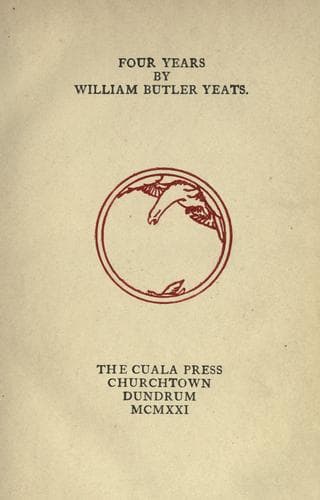
Poets, Irish -- 20th century -- Biography; Yeats, W. B. (William Butler), 1865-1939
Turning and turning in the widening gyre
The falcon cannot hear the falconer;
Things fall apart; the centre cannot hold;
Mere anarchy is loosed upon the world,
The blood-dimmed tide is loosed, and everywhere
The ceremony of innocence is drowned;
The best lack all conviction, while the worst
Are full of passionate intensity.
XXI
The Huxley, Tyndall, Carolus Duran, Bastien-Lepage coven asserted
that an artist or a poet must paint or write in the style of his
own day, and this with 'The Fairy Queen,' and 'Lyrical Ballads,'
and Blake's early poems in its ears, and plain to the eyes, in
book or gallery, those great masterpieces of later Egypt, founded
upon that work of the Ancient Kingdom already further in time from
later Egypt than later Egypt is from us. I knew that I could
choose my style where I pleased, that no man can deny to the human
mind any power, that power once achieved; and yet I did not wish
to recover the first simplicity. If I must be but a shepherd
building his hut among the ruins of some fallen city, I might take
porphyry or shaped marble, if it lay ready to my hand, instead of
the baked clay of the first builders. If Chaucer's personages had
disengaged themselves from Chaucer's crowd, forgotten their common
goal and shrine, and after sundry magnifications become, each in
his turn, the centre of some Elizabethan play, and a few years
later split into their elements, and so given birth to romantic
poetry, I need not reverse the cinematograph. I could take those
separated elements, all that abstract love and melancholy, and
give them a symbolical or mythological coherence. Not Chaucer's
rough-tongued riders, but some procession of the Gods! a
pilgrimage no more but perhaps a shrine! Might I not, with health
and good luck to aid me, create some new 'Prometheus Unbound,'
Patrick or Columbcille, Oisin or Fion, in Prometheus's stead, and,
instead of Caucasus, Croagh-Patrick or Ben Bulben? Have not all
races had their first unity from a polytheism that marries them to
rock and hill? We had in Ireland imaginative stories, which the
uneducated classes knew and even sang, and might we not make those
stories current among the educated classes, re-discovering for the
work's sake what I have called 'the applied arts of literature,'
the association of literature, that is, with music, speech and
dance; and at last, it might be, so deepen the political passion
of the nation that all, artist and poet, craftsman and day
labourer would accept a common design? Perhaps even these images,
once created and associated with river and mountain, might move of
themselves, and with some powerful even turbulent life, like those
painted horses that trampled the rice fields of Japan.
XXII
Public-domain text, read in full here on John Shaqi.
Reviews
Reviews
No reviews yet
Be the first to share your thoughts on this work.
Join the Discussion
Join the discussion
Sign in to leave a comment or review.
Sign InorCreate an account