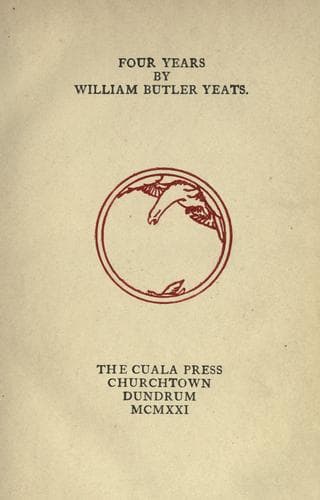
Poets, Irish -- 20th century -- Biography; Yeats, W. B. (William Butler), 1865-1939
I used to tell the few friends to whom I could speak these secret
thoughts that I would make the attempt in Ireland but fail, for
our civilisation, its elements multiplying by divisions like
certain low forms of life, was all powerful; but in reality I had
the wildest hopes. To-day I add to that first conviction, to that
first desire for unity, this other conviction, long a mere opinion
vaguely or intermittently apprehended: Nations, races and
individual men are unified by an image, or bundle of related
images, symbolical or evocative of the state of mind, which is of
all states of mind not impossible, the most difficult to that man,
race or nation; because only the greatest obstacle that can be
contemplated without despair rouses the will to full intensity. A
powerful class by terror, rhetoric, and organised sentimentality,
may drive their people to war, but the day draws near when they
cannot keep them there; and how shall they face the pure nations
of the East when the day comes to do it with but equal arms? I had
seen Ireland in my own time turn from the bragging rhetoric and
gregarious humour of O'Connell's generation and school, and offer
herself to the solitary and proud Parnell as to her anti-self,
buskin following hard on sock; and I had begun to hope, or to
half-hope, that we might be the first in Europe to seek unity as
deliberately as it had been sought by theologian, poet, sculptor,
architect from the eleventh to the thirteenth century. Doubtless
we must seek it differently, no longer considering it convenient
to epitomise all human knowledge, but find it we well might, could
we first find philosophy and a little passion.
XXIII
It was the death of Parnell that convinced me that the moment had
come for work in Ireland, for I knew that for a time the
imagination of young men would turn from politics. There was a
little Irish patriotic society of young people, clerks, shop-boys,
shop-girls, and the like, called the Southwark Irish Literary
Society. It had ceased to meet because each member of the
committee had lectured so many times that the girls got the
giggles whenever he stood up. I invited the committee to my
father's house at Bedford Park and there proposed a new
organisation. After a few months spent in founding, with the help
of T. W. Rolleston, who came to that first meeting and had a
knowledge of committee work I lacked, the Irish Literary Society,
which soon included every London Irish author and journalist, I
went to Dublin and founded there a similar society.
W. B. Yeats.
Here ends 'Four Years,' written by
William Butler Yeats. Four hundred
copies of this book have been
printed and published by Elizabeth
C. Yeats on paper made in Ireland,
at the Cuala Press, Churchtown,
Dundrum, in the County of Dublin,
Ireland. Finished on All Hallows'
Eve, in the year nineteen hundred
and twenty one.
Public-domain text, read in full here on John Shaqi.
Reviews
Reviews
No reviews yet
Be the first to share your thoughts on this work.
Join the Discussion
Join the discussion
Sign in to leave a comment or review.
Sign InorCreate an account