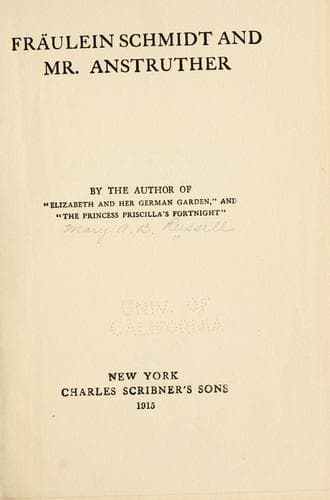
Fräulein Schmidt and Mr. AnstrutherVon Arnim, Elizabeth
General
Fräulein Schmidt and Mr. Anstruther
Von Arnim, Elizabeth
British -- Germany -- Fiction; Epistolary fiction; Germany -- Fiction; Love stories; Young women -- Fiction
That sponge had no effect yesterday. I stared and stared at it, and it
only remained a sponge, far too small for the really cleanly, instead of
what it has up to now been, the starting-point for a train of thrilling,
enthusiastic thoughts. I'm an unbalanced creature. Do you divide your
time too, I wonder, between knocking your head against the stars and, in
some freezing depth of blackness, listening to your heart, how it will
hardly beat for fear? Of course you don't. You are much too clever. And
then you have been educated, trained, taught to keep your thoughts
within bounds, and not let them start off every minute on fresh and
aimless wanderings. Yet the star-knocking is so wonderful that I believe
I would rather freeze the whole year round for one hour of it than go
back again to the changeless calm, the winter-afternoon sunshine, in
which I used to sit before I knew you. All this only means that you have
not written. See how variously one can state a fact.
I have run away from the sitting-room and the round table and the lamp,
because Papa and my step-mother had begun to discuss you again, your
prospects, your probable hideous fate if you were not prudent, your
glorious career if you were. I felt guilty, wounded, triumphant, vain,
all at once. Papa, of course, was chiefly the listener. He agreed; or at
most he temporized. I tell you, Roger, I am amazed at the power a woman
has over her husband if she is in _every_ way inferior to him. It is not
only that, as we say, _der Klügere giebt nach_, it is the daily complete
victory of the coarser over the finer, the rough over the gentle, the
ignorant over the wise. My step-mother is an uneducated person, shrewd
about all the things that do not matter, unaware of the very existence
of the things that do, ready to be charitable, helpful, where the
calamity is big enough, wholly unsympathetic, even antagonistic, toward
all those many small calamities that make up one's years; the sort of
woman parsons praise, and who get tombstones put over them at last
peppered with frigid adjectives like virtuous and just. Did you ever
chance to live with a just person? They are very chilling, and not so
rare as one might suppose. And Papa, laxest, most tolerant of men, so
lax that nothing seems to him altogether bad, so tolerant that nobody,
however hard he tries, can pass, he thinks, beyond the reach of
forgiveness and love, so humorous that he has to fight continually to
suppress it, for humor lands one in odd morasses of dislike and
misconception here, married her a year after my mother died, and did it
wholly for my sake. Imagine it. She was to make me happy. Imagine that
too. I was not any longer to be a solitary _Backfisch_, with holes in
her stockings and riotous hair. There came a painful time when Papa
began to suspect that the roughness of my hair might conceivably be a
symbol of the dishevelment of my soul. Neighboring matrons pointed out
the possibility to him.
Public-domain text, read in full here on John Shaqi.
Reviews
Reviews
No reviews yet
Be the first to share your thoughts on this work.
Join the Discussion
Join the discussion
Sign in to leave a comment or review.
Sign InorCreate an account