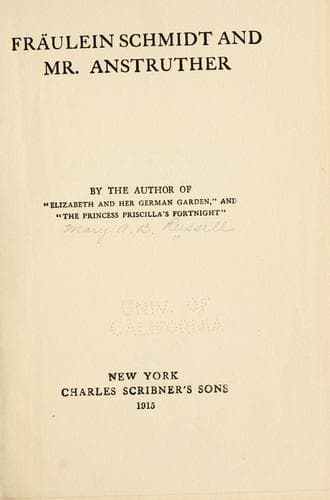
Fräulein Schmidt and Mr. AnstrutherVon Arnim, Elizabeth
General
Fräulein Schmidt and Mr. Anstruther
Von Arnim, Elizabeth
British -- Germany -- Fiction; Epistolary fiction; Germany -- Fiction; Love stories; Young women -- Fiction
He took to peering anxiously at unimportant
parts of me such as my nails, and was startled to see them often black.
He caught me once or twice red-eyed in corners, when it had happened
that the dear ways and pretty looks of my darling mother had come back
for a moment with extra vividness. He decided that I was both dirty and
wretched, and argued, I am sure during sleepless nights, that I would
probably go on being dirty and wretched for ever. And so he put on his
best clothes one day, and set out doggedly in search of a wife.
He found her quite easily, in a house in the next street. She was making
doughnuts, for it was the afternoon of New Year's Eve. She had just
taken them out of the oven, and they were obviously successful. Papa
loves doughnuts. His dinner had been uneatable. The weather was cold.
She took off her apron, and piled them on a dish, and carried them,
scattering fragrance as they went, into the sitting-room; and the smell
of them was grateful; and they were very hot.
Papa came home engaged. 'I am not as a rule in favor of second
marriages, Rose-Marie,' he began, breaking the news to me with elaborate
art.
'Oh, horrid things,' I remarked, my arm round his neck, my face against
his, for even then I was as tall as he. You know how he begins abruptly
about anything that happens to cross his mind, so I was not surprised.
He rubbed his nose violently. 'I never knew anybody with such hair as
yours for tickling a person,' he said, trying to push it back behind my
ears. Of course it would not go. 'Would it do that,' he added
suspiciously, 'if it were properly brushed?'
'I don't know. Well, _Papachen_?'
'Well what?'
'About second marriages.'
He had forgotten, and he started. In an instant I knew. I took my arm
away quickly, but put it back again just as quickly and pressed my face
still closer: it was better we should not see each other's eyes while he
told me.
'I am not, as a rule, in favor of them,' he repeated, when he had
coughed and tried a second time to induce my hair to go behind my ears,
'but there are cases where they are--imperative.'
'Which ones?'
'Why, if a man is left with little children, for instance.'
'Then he engages a good nurse.'
'Or his children run wild.'
'Then he gets a severe aunt to live with him.'
'Or they grow up.'
'Then they take care of themselves.'
'Or he is an old man left with, say, one daughter.'
'Then she would take care of him.'
'And who would take care of her, Rose-Marie?'
'He would.'
'And if he is an incapable? An old person totally unable to notice
lapses from convention, from social customs? If no one is there to tell
her how to dress and how to behave? And she is growing up, and yet
remains a barbarian, and the day is not far distant when she must go
out, and he knows that when she does go out Jena will be astounded.'
'Does the barbarian live in Jena?'
'My dear, she is universal. Wherever there is a widower with an only
female child, there she is.'
Public-domain text, read in full here on John Shaqi.
Reviews
Reviews
No reviews yet
Be the first to share your thoughts on this work.
Join the Discussion
Join the discussion
Sign in to leave a comment or review.
Sign InorCreate an account