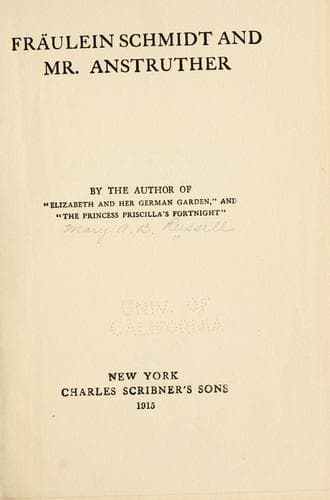
Fräulein Schmidt and Mr. AnstrutherVon Arnim, Elizabeth
General
Fräulein Schmidt and Mr. Anstruther
Von Arnim, Elizabeth
British -- Germany -- Fiction; Epistolary fiction; Germany -- Fiction; Love stories; Young women -- Fiction
I am glad you did not laugh at that silly letter of mine about scorching
in the sun on rocks. Indeed I gather, my dear Roger, that you liked it.
Make the most of it then, for there will be no more of the sort. A
decent woman never gets on to rocks, and if she scorches she doesn't say
so. And I believe that it is held to be generally desirable that she
should not, even under really trying circumstances, part with her
dignity. I rather think the principle was originally laid down by the
husband of an attractive wife, but it is a good one, and so long as I am
busy clinging to my dignity obviously I shall have no leisure for
clinging to you, and then you will not be suffocated with the
superabundance of my follies.
About those two sinners who are appalling us: how can I agree with you?
To do so would cut away the ground from under my own feet. The woman
plays such a losing game. She gives so much, and gets so little. So long
as the man loves her I do see that he is worth the good opinion of
neighbors and relations, which is one of the chilliest things in the
world; but he never seems able to go on loving her once she has begun to
wither. That is very odd. She does not mind his withering. And has she
not a soul? And does not that grow always lovelier? But what, then,
becomes of her? For wither she certainly will, and years rush past at
such a terrific pace that almost before she has begun to be happy it is
over. He goes back to his wife, a person who has been either patient or
bitter according to the quantity of her vitality and the quality of her
personal interests, and concludes, while he watches her sewing on his
buttons in the corner she has probably been sitting in through all his
vagrant years, that marriage has its uses, and that it is good to know
there will be some one bound to take care of you up to the last, and who
will shed decent tears when you are buried. She goes back--but where,
and to what? They have gone long ago, her husband, her children, her
friends. And she is old, and alone. You too, like everybody else, seem
unable to remember how transient things are. Time goes, emotions wear
out. You say these people are in the hands of Fate, and can no more get
out of them and do differently than a fly in a web can walk away when it
sees the hungry spider coming nearer. I don't believe in webs and
spiders; at least, I don't today. Today I believe only in my
unconquerable soul--
I am the master of my fate,
I am the captain of my soul.
Public-domain text, read in full here on John Shaqi.
Reviews
Reviews
No reviews yet
Be the first to share your thoughts on this work.
Join the Discussion
Join the discussion
Sign in to leave a comment or review.
Sign InorCreate an account