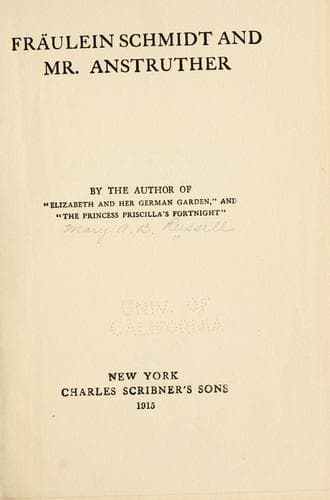
Fräulein Schmidt and Mr. AnstrutherVon Arnim, Elizabeth
General
Fräulein Schmidt and Mr. Anstruther
Von Arnim, Elizabeth
British -- Germany -- Fiction; Epistolary fiction; Germany -- Fiction; Love stories; Young women -- Fiction
And you say that a person in the grip of a great feeling should not care
a straw for circumstance, should defy it, trample it under foot. Heaven
knows that I too am for love and laughter, for the snatching of flying
opportunities, for all that makes the light and the glory of life; but
what afterwards? The Afterwards haunts me like a weeping ghost. It is
true there is still the wide world, the warm sun, seed-time and harvest,
Shakespeare, the Book of Job, singing birds, flowers; but the soul that
has transgressed the laws of man seems for ever afterwards unable to use
the gifts of God. If supreme joy could be rounded off by death, death at
the exact right moment, how easy things would be. Only death has a
strange way of shunning those persons who want him most. To long to die
seems to make you as nearly immortal as it is possible to become. Now
just think what would have happened if Tristan had not been killed, had
lived on quite healthily. King Mark, than whom I know no man in
literature more polite, would have handed Isolde over to him as he
declared himself ready to have done had he been aware of the
unfortunately complicated state of things, and he would have done it
with every expression of decent regret at the inconvenience he had
caused. Isolde would have married Tristan. There would have been no
philosophy, no divine hours in the garden, no acute, exquisite anguish
of love and sorrow. But there would presently have been the Middle Ages
equivalent for a perambulator, a contented Tristan coming to meet it, a
faded Isolde who did not care for poetry, admonishing, perhaps with
sharpness, a mediæval nursemaid, and quite quickly afterwards a Tristan
grown too comfortable to move, and an Isolde with wrinkles. Would we not
have lost a great deal if they had lived? It is certain that they
themselves would have lost a great deal; for I don't see that
contentment beaten out thin enough to cover a long life--and beat as
thin as you will it never does cover quite across the years--is to be
compared with one supreme contentment heaped in one heap on the highest,
keenest point of living we reach. Now I am apparently arguing on your
side, but I'm not really, because you, you know, think of love as a
perpetual _crescendo,_ and I, though I do hear the _crescendo_ and
follow it with a joyful clapping of hands up to the very top of its
splendor, can never forget the drop on the other side, the inevitable
_diminuendo_ to the dead level--and then? Why, the rest is not even
silence, but a querulous murmur, a querulous, confused whining, confused
complaining, not very loud, not very definite, but always there till the
last chord is reached a long time afterwards--that satisfactory common
chord of death. My point is, that if you want to let yourself go to
great emotions you ought to have the luck to die at an interesting
moment. The alternative makes such a dreary picture; and it is the
picture I always see when I hear of love at defiance with the law. The
Public-domain text, read in full here on John Shaqi.
Reviews
Reviews
No reviews yet
Be the first to share your thoughts on this work.
Join the Discussion
Join the discussion
Sign in to leave a comment or review.
Sign InorCreate an account