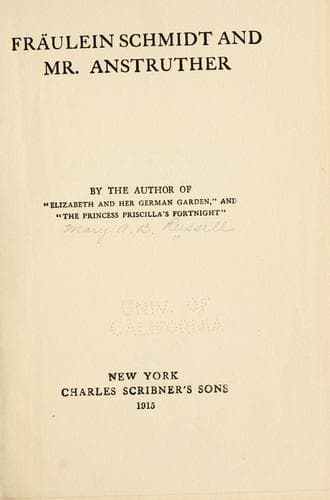
Fräulein Schmidt and Mr. AnstrutherVon Arnim, Elizabeth
General
Fräulein Schmidt and Mr. Anstruther
Von Arnim, Elizabeth
British -- Germany -- Fiction; Epistolary fiction; Germany -- Fiction; Love stories; Young women -- Fiction
law wins; always, inevitably. Husbands are best; always, inevitably.
Really, the most unsatisfactory husband is a person who should be clung
to steadily from beginning to end, for did not one marry him of one's
own free will? How ugly then, because one had been hasty, foolish,
unacquainted with one's usually quite worthless mind, to punish him. The
brilliant professor, the fascinating little lady, what are they but
grossly selfish people, cruelly punishing the husband and wife who had
the misfortune to marry them? Oh, it's a mercy most of us are homely,
slow of wit, heavy of foot; for so at least we stay at home and find our
peace in fearful innocence and household laws. (Please note my
familiarity with the British poets.) But isn't that a picture of frugal
happiness, of the happiness that comes from a daily simple obedience to
the Stern Daughter of the Voice of God, beside which stormy, tremendous,
brief things come off very badly? I don't believe you do in your heart
side with the two sinners. Bother them. They have made me feel like a
Lutheran pastor on a Sunday afternoon. But you know I love you.
R.-M.
XII
Jena, Nov. 22d.
When do you go back to Jermyn Street? Surely today, for is not the
examination to-morrow? Your description of the Cheriton _ménage_ at
Clinches is like fairyland. No wonder you feel so happy there. My mother
used to tell me about life in England, but apparently the Watson family
did not dwell in houses like Clinches. Anyhow I had an impression of
little houses with little staircases, and oil-cloth, and a servant in a
cap with streamers, and round white balls of suet with currants in them
very often for dinner. But Clinches, beautiful and dignified in the
mists and subtleties of a November afternoon, its massed grayness
melting into that other grayness, its setting of mysterious blurred wood
and pale light of water, its spaciousness, its pleasant people, its
daughter with the dusky hair and odd gray eyes--is a vision of
fairyland. I cannot conceive what life is like in such places; nor I am
sure could any other inhabitant of Jena. What, for instance, can it be
like to live in a thing so big that you do not hear the sounds nor smell
the smells of the kitchen? Ought not people who live in such places to
have unusually beautiful ways of looking at life? of thinking? of
speaking? One imagines it all very noble, very gracious, altogether
worthy. That complete separation from the kitchen is what wrings the
biggest sigh of envy out of me. Is it my English blood that makes me
rebel against kitchens? Or is it only my unfortunate sensitiveness to
smell? I wish I had no nose. It has always been a nuisance. It is as
extravagantly delighted by exquisite scents as it is extravagantly
horrified by nasty ones. Why, a beautiful smell, if it is delicate,
subtle, intermittent, can ruin a morning for me. It fills me with a
quite unworthy rapture. Things that ought to be hard in me melt. Things
Public-domain text, read in full here on John Shaqi.
Reviews
Reviews
No reviews yet
Be the first to share your thoughts on this work.
Join the Discussion
Join the discussion
Sign in to leave a comment or review.
Sign InorCreate an account