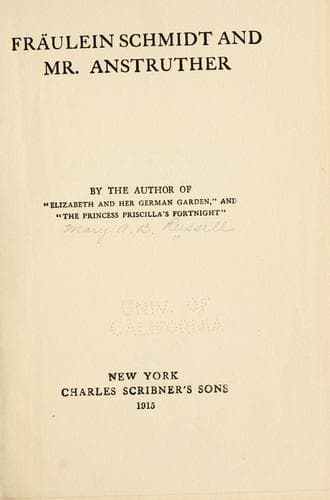
Fräulein Schmidt and Mr. AnstrutherVon Arnim, Elizabeth
General
Fräulein Schmidt and Mr. Anstruther
Von Arnim, Elizabeth
British -- Germany -- Fiction; Epistolary fiction; Germany -- Fiction; Love stories; Young women -- Fiction
I have not thanked you for the book you sent me. It was very kind indeed
of you to wish me to share the pleasure you have had in reading it. But
see how unfortunately contrary I am: I don't care about it. And just the
passages you marked are the ones I care about least. I do not hold with
markings in books. Whenever I have come across mine after a lapse of
years I have marvelled at the distance travelled since I marked, and
shut up the book and murmured, 'Little fool.' I can't imagine why you
thought I should like this book. It has given me rather a surprised
shock that you should know me so little, and that I should know you so
little as to think you knew me better. Really all the explanations and
pointings in the world will not show a person the exact position of his
neighbor's soul. It is astonishing enough that the book was printed, but
how infinitely more astonishing that people like you should admire it.
What is the matter with me that I cannot admire it? Why am I missing
things that ought to give me pleasure? You do not, then, see that it is
dull? I do. I see it and feel it in every bone, and it makes them ache.
It is dull and bad because it is so dreary, so hopelessly dreary. Life
is not like that. Life is only like that to cowards who are temporarily
indisposed. I do not care to look at it through a sick creature's
jaundiced eyes and shudder with him at what he sees. If he cannot see
better why not keep quiet, and let us braver folk march along with our
heads in the air, held so high that we cannot bother to look at every
slimy creepiness that crawls across our path? And did you not notice how
he keeps on telling his friends in his letters not to mind when he is
dead? Unnecessary advice, one would suppose; I can more easily imagine
the friends gasping with an infinite relief. Persons who are
everlastingly claiming pity, sympathy, condolences, are very wearing.
Surely all talk about one's death is selfish and bad? That is why,
though there is so much that is lovely in them, the faint breath of
corruption hanging about Christina Rossetti's poetry makes me turn my
head the other way. What a constant cry it is that she wants to die,
that she hopes to die, that she's going to die, shall die, can die, must
die, and that nobody is to weep for her but that there are to be
elaborate and moving arrangements of lilies and roses and
winding-sheets. And at least in one place she gives directions as to the
proper use of green grass and wet dewdrops upon her grave--implying that
dewdrops are sometimes dry. I think the only decent attitude toward
one's death is to be silent. Talk about it puts other people in such an
awkward position. What is one to say to persons who sigh and tell us
that they will no doubt soon be in heaven? One's instinct is politely to
murmur, 'Oh no,' and then they are angry. 'Surely not,' also has its
pitfalls. Cheery words, of the order in speech that a slap on the
Public-domain text, read in full here on John Shaqi.
Reviews
Reviews
No reviews yet
Be the first to share your thoughts on this work.
Join the Discussion
Join the discussion
Sign in to leave a comment or review.
Sign InorCreate an account