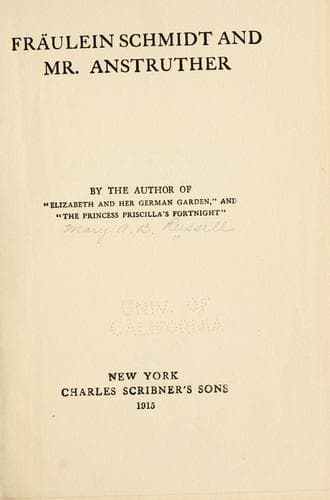
Fräulein Schmidt and Mr. AnstrutherVon Arnim, Elizabeth
General
Fräulein Schmidt and Mr. Anstruther
Von Arnim, Elizabeth
British -- Germany -- Fiction; Epistolary fiction; Germany -- Fiction; Love stories; Young women -- Fiction
shoulder is in the sphere of physical expression, only seem to deepen
the determined gloom. And if it is some one you love who thinks he will
soon be dead and tells you so, the cruelty is very great. When death
really comes, is not what the ordinary decent dier wants quiet, that he
may leave himself utterly in the hands of God? There should be no
massing of temporarily broken-hearted onlookers about his bed, no
leave-takings and eager gatherings-up of last words, no revellings of
relatives in the voluptuousness of woe, no futile exhortations, using up
the last poor breaths, not to weep to persons who would consider it
highly improper to leave off doing it, and no administration of tardy
blessings. Any blessings the dier has to invoke should have been invoked
and done with long ago. In this last hour, at least, can one not be left
alone? Do you remember Pater's strange feeling about death? Perhaps you
do not, for you told me once you did not care about him. Well, it runs
through his books, through all their serenity and sunlight, through
exquisite descriptions of summer, of beautiful places, of heat and life
and youth and all things lovely, like a musty black riband, very poor,
very mean, very rotten, that yet must bind these gracious flowers of
light at last together, bruising them into one piteous mass of
corruption. It is all very morbid: the fair outward surface of daily
life, the gay, flower-starred crust of earth, and just underneath
horrible tainted things, things forlorn and pitiful, things which we who
still walk on the wholesome grass must soon join, changing our life in
the roomy sunshine into something infinitely dependent and helpless,
something that can only dimly live if those strong friends of ours in
the bright world will spare us a thought, a remembrance, a few minutes
from their plenty for sitting beside us, room in their hearts for yet a
little love and sorrow. 'Dead cheek by dead cheek, and the rain soaking
down upon one from above....' Does not that sound hopeless? After
reading these things, sweet with the tainted sweetness of decay, of,
ruin, of the past, the gone, it is like having fresh spring water dashed
over one on a languid afternoon to remember Walt Whitman's brave
attitude toward 'delicate death,' 'the sacred knowledge of death,'
'lovely, soothing death,' 'cool, enfolding death,' 'strong deliveress,'
'vast and well-veiled death,' 'the body gratefully nestling close to
death,' 'sane and sacred death.' That is the spirit that makes one brave
and fearless, that makes one live beautifully and well, that sends one
marching straight ahead with limbs that do not tremble and head held
high. Is it not natural to love such writers best? Writers who fill one
with glad courage and make one proud of the path one has chosen to walk
in?
Public-domain text, read in full here on John Shaqi.
Reviews
Reviews
No reviews yet
Be the first to share your thoughts on this work.
Join the Discussion
Join the discussion
Sign in to leave a comment or review.
Sign InorCreate an account