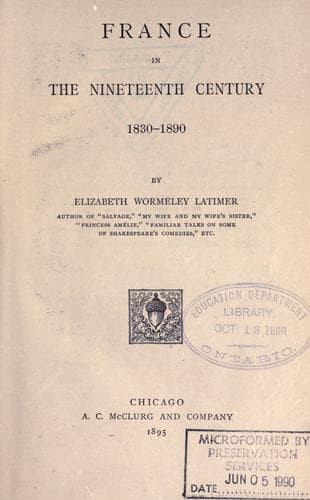
France in the Nineteenth CenturyLatimer, Elizabeth Wormeley
History
France in the Nineteenth Century
Latimer, Elizabeth Wormeley
France -- History -- 1789-1900
"People ask what he does with his money. To satisfy them it would
be necessary to publish the names of honorable friends of liberty
who, in consequence of misfortunes, have solicited and obtained
from him sums of twenty, thirty, forty, and even three hundred
thousand francs. They forget all the extraordinary expenses my
brother has had to meet, all the demands he has to comply with.
Out of his income he has furnished the Palais Royal, improved the
_apanages_ of the House of Orleans; and yet sooner or later all
this property will revert to the nation. When we returned to France
our inheritance was so encumbered that my brother was advised to
decline administering on the estate; but to that neither he nor
I would consent. For all these things people make no allowances.
Truly, we know not how to act to inspire the confidence which our
opinions and our consciences tell us we fully deserve."
[Footnote 1: M. Appert, chaplain to Queen Marie Amélie.]
[Illustration: _LOUIS PHILLIPPE_. (_Duke of Orleans_.)]
It is not necessary in a sketch so brief to go minutely into politics.
Prince Polignac and the king dissolved the Chambers, having found the
deputies unwilling to approve their acts, and a few days afterwards
the king published his own will and pleasure in what were called
_Les Ordonnances du Roi_. One of these restricted the liberty of
the Press, and was directed against journalism; another provider
new rules, by which the ministry might secure a more subservient
Chamber.
As we have seen, these _ordonnances_ even in foreign countries
spread dismay. The revolution that ensued was the revolution of
the great bankers and the business men,--the _haute bourgeoisie_.
In general, revolutions are opposed by the moneyed classes; but
this was a revolution effected by them to save themselves and their
property from such an outbreak as came forty years later, which
we call the Commune. The working-classes had little to do with
the Revolution of 1830, except, indeed, to fight for it, nor had
they much to do with the Revolution of 1848. It was the moneyed
men of France who saw that the resuscitated principles of the old
régime had been stretched to their very uttermost all over Europe,
and that if they did not check them by a well-conducted revolution,
worse would be sure to come.
On July 26, 1830, the _ordonnances_ appeared. The working-classes
seemed to hear of them without emotion; but their effect on all those
who had any stake in the prosperity of the country was very great.
By nightfall the agitation had spread in Paris to all classes. King
Charles X. was at Saint-Cloud, apparently apprehending no popular
outbreak. No military preparations in case of disturbances had been
made, though on the morning of the 26th the Duc d'Angoulême sent
word to Marshal Marmont to take command of the troops in Paris,
"as there might be some windows broken during the day."
Public-domain text, read in full here on John Shaqi.
Reviews
Reviews
No reviews yet
Be the first to share your thoughts on this work.
Join the Discussion
Join the discussion
Sign in to leave a comment or review.
Sign InorCreate an account