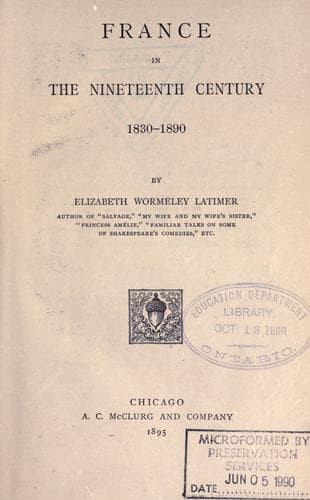
France in the Nineteenth CenturyLatimer, Elizabeth Wormeley
History
France in the Nineteenth Century
Latimer, Elizabeth Wormeley
France -- History -- 1789-1900
The next morning trouble was begun by the journeymen printers,
who, as the newspapers on which they worked had been prohibited,
were sent home from their printing-offices. Before long they were
joined by others, notably by the cadets from the Polytechnic School.
Casimir Perrier and Laffitte were considered chiefs of the revolution.
The cry was everywhere "Vive la Charte,"--a compendium that had
been drawn up of the franchises and privileges of Frenchmen. M.
Thiers, then young, counselled moderation in the emergency.
On July 28 the tricolored flag was again unfurled in Paris,--those
colors dear to Frenchmen, who had long hated the white flag, which
represented in their eyes despotism and the rule of the Bourbons!
The National Guard (or militia) was called out, and the populace
began erecting barricades.
It is surprising how rapidly in an emergency a barricade can be
formed. A carriage or two is overturned, furniture is brought out
from neighboring houses, a large tree, if available, is cut down,
and the whole is strengthened with paving-stones. By night all
Paris had become a field of battle.
In vain Marshal Marmont had sent courier after courier to Saint-Cloud,
imploring the king and his ministers to do something that might allay
the fury of the people. No answer was returned. The marshal went
himself at last, and the king, after listening to his representation
of the state of Paris, said calmly: "Then it is really a revolt?"
"No, sire," replied Marmont; "it is not a revolt, but a revolution."
As soon as the idea of ruin broke upon the royal household, everything
at Saint-Cloud became confusion and despair. The Duchesse de Berri
wanted to take her son, the Duc de Bordeaux, into Paris, hoping
that the people would rally round a woman and the young heir to
the throne. Some implored the king to treat with the insurgents;
some to put himself at the head of his troops; some to sacrifice
the _ordonnances_ and the most obnoxious of his ministers.
The Parisian mob by this time had its blood up. It fought with any
weapons that came to hand. Muskets were loaded with type seized in
the printing-offices. At the Hôtel-de-Ville, Laffitte, Lafayette,
and other leading men opposed to the policy of Charles X. were
assembled in council.
The troops at first fought in their king's cause bravely, but without
enthusiasm. Subsequently the Duke of Wellington was asked if he
could not have suppressed the revolution with the garrison of Paris,
which was twenty thousand men. He answered, "Easily; but then they
must have been fighting for a cause they had at heart."
The fight continued all the night of the 28th, bloody and furious.
By morning the soldiers were short of ammunition. As usual, the
Swiss Guard was stanch, but the French soldiers faltered. About
midday of the 29th two regiments went over to the insurgents.
Public-domain text, read in full here on John Shaqi.
Reviews
Reviews
No reviews yet
Be the first to share your thoughts on this work.
Join the Discussion
Join the discussion
Sign in to leave a comment or review.
Sign InorCreate an account