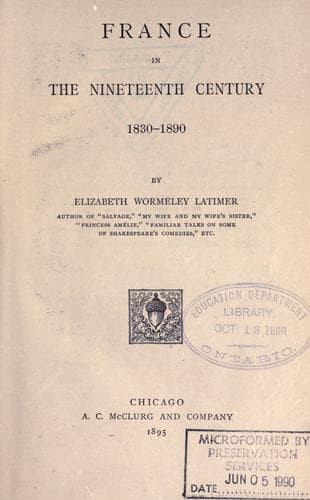
France in the Nineteenth CenturyLatimer, Elizabeth Wormeley
History
France in the Nineteenth Century
Latimer, Elizabeth Wormeley
France -- History -- 1789-1900
For a while the prince president governed by decrees; then a new
legislative body was assembled. Its first duty was to revise the
constitution. The republican constitution of 1850 was in the main
re-adopted, but with one important alteration. The prince president
was to be turned into the Emperor Napoleon III., and the throne
was to be hereditary in his family.
After the passage of this measure it was submitted by another
_plébiscite_ to the people. The _plébiscite_ is a universal suffrage
vote of yes or no, in answer to some question put by the Government
to the nation. The question this time was: Shall the prince president
become emperor? There were 7,800,000 ayes, and 224,000 noes.
When the news of this overwhelming success reached the Élysée,
Louis Napoleon sat so still and unmoved, smoking his cigar, that
his cousin, Madame Baiocchi, rushing up to him, shook him, and
exclaimed: "Is it possible that you are made of stone?"
Having thus secured his elevation by the almost universal consent
of Frenchmen, the new emperor's next step was to insure his dynasty
by a marriage that might probably give heirs to the throne. He
chose the title Napoleon III. because the son of the Great Napoleon
had been Napoleon II. for a few days after his father's abdication
at Fontainebleau in 1814. The next heir to the imperial dignities
(Lucien Bonaparte having refused anything of the kind for himself
or for his family) was Jérôme Napoleon, familiarly called Plon-Plon.
He was the only son of Jérôme Bonaparte and the Princess Catherine
of Würtemberg. But Prince Napoleon, though clever, was wilful and
eccentric, and made a boast of being a Red Republican; moreover,
his father's Baltimore marriage had made his legitimacy more than
doubtful,--at any rate, Louis Napoleon was by no means desirous
of passing on to him the succession to the empire; and being now
forty-four years old, he was desirous of marrying as soon as possible.
When a boy, it had been proposed to marry him to his cousin Mathilde,
and something like an attachment had sprung up between them; but
after his fiasco at Strasburg he was no longer considered an eligible
suitor either for Princess Mathilde or another cousin who had been
named for him, a princess of Baden. Princess Mathilde was married
to the Russian banker, Prince Demidorff; but when Louis Napoleon
became prince president, he requested her to preside at the Élysée.
Public-domain text, read in full here on John Shaqi.
Reviews
Reviews
No reviews yet
Be the first to share your thoughts on this work.
Elsewhere in the archive
Join the Discussion
Join the discussion
Sign in to leave a comment or review.
Sign InorCreate an account