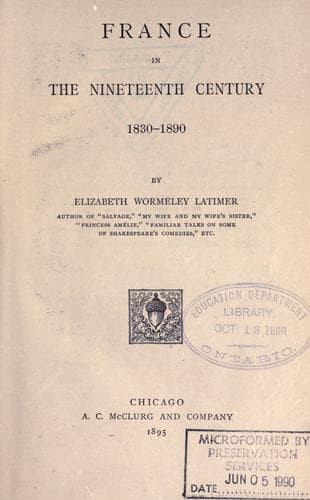
France in the Nineteenth CenturyLatimer, Elizabeth Wormeley
History
France in the Nineteenth Century
Latimer, Elizabeth Wormeley
France -- History -- 1789-1900
The new emperor, or his advisers, looked round at the various
marriageable princesses belonging to the smaller courts of Germany.
The sister of that Prince Leopold of Hohenzollern whose selection for
the throne of Spain led afterwards to the Franco-Prussian war, was
spoken of; but the lady most seriously considered was the Princess
Adélaïde of Hohenlohe. She was daughter of Queen Victoria's half-sister
Feodora; and to Queen Victoria and Prince Albert, as heads of the
family, the matter was referred. A recent memoir-writer tells us of
seeing the queen at Windsor when the matter was under discussion.
The queen and her husband were apparently not averse to the alliance,
hesitating only on the grounds of religion and morals; but it is
doubtful how far the new emperor went personally in the affair.
His inclination had for some time pointed to the reigning beauty
of Paris, Mademoiselle Eugénie de Montijo.
This young lady's grandfather was Captain Fitzpatrick, of a good old
Scottish family, which had in past times married with the Stuarts.
Captain Fitzpatrick had been American consul at a port in southern
Spain. He had a particularly charming daughter, who made a brilliant
Spanish marriage, her husband being the Count de Teba (or Marquis
de Montijo, for he bore both titles). The Montijos were connected
with the grandest ducal families in Spain and Portugal, and even
with the royal families of those nations.
The Count de Teba died while his two daughters were young, and they
were left under the guardianship of their very charming mother.
The elder married the Duke of Alva; the younger became the Empress
Eugénie.
Eugénie was for some time at school in England at Clifton. She
was described by those who knew her there as a pretty, sprightly
little girl, much given to independence, and something of a tom
boy,--a character there is reason to think she preserved until
it was modified by the exigencies of her position.
Mr. George Ticknor, of Boston, frequently mentioned Madame de Teba
to his friends as a singularly charming woman. In 1818 he wrote
home to a friend in America:
Public-domain text, read in full here on John Shaqi.
Reviews
Reviews
No reviews yet
Be the first to share your thoughts on this work.
Elsewhere in the archive
Join the Discussion
Join the discussion
Sign in to leave a comment or review.
Sign InorCreate an account