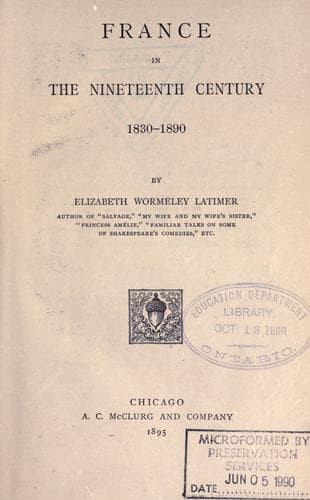
France in the Nineteenth CenturyLatimer, Elizabeth Wormeley
History
France in the Nineteenth Century
Latimer, Elizabeth Wormeley
France -- History -- 1789-1900
In feudal times cities all over Europe won for themselves charters.
By these charters they acquired the right to govern themselves;
that is, the burghers elected their own mayor and their councilor
aldermen, and this body governing the community was called the
commune. When the feudal system fell in France, and all power was
centralized in the king, city governments were established by royal
edict only. Paris, for instance, was governed by the Prefect of the
Seine,--he had under him the _maires_ of twenty Arrondissements;
and thus it was in every French city. All public offices in France
were in the gift of the Throne.
To Americans, who have mayors and city councils in every city,
municipal taxation, municipal elections, and municipal laws, a
commune appears the best mode of city government. But if we can
imagine one of our large cities possessing the same power over
the United States that Paris wields over France, we shall take a
different view of the matter. Paris governed by a commune, that
commune being elected by a mob and aspiring to give laws to France,
might well indeed have alarmed all Frenchmen. We may judge of its
feeling towards the Provinces from the indignation expressed by
Parisian Communists when during the Commune, Lyons and some other
cities talked of setting up communes of their own.
In olden times, in France, Italy, and Germany (as in Great Britain
at the present day), it was not the mob, but the burghers, whose
interests depended upon the prosperity of their city, who voted
in municipal elections. France had established universal suffrage,
and the restless "men of Belleville,"--the "white blouses,"--were
liable in any time of excitement to be joined by roughs from other
cities, and by all working-men out of employment. These apprehensions
of the respectable citizens of Paris were horribly realized in
1871. The new Republic, meantime, was not Red, not Communistic,
not Socialistic, but Republican.
During the Revolution of 1848 there had been little intoxication
in Paris; but in the twenty-two years that followed, the French
had learned to drink absinthe and to frequent such places as
"L'Assommoir." All accounts speak of the drunkenness in France during
the Franco-Prussian war.
Meantime, during the two weeks that preceded the arrival of the
Prussians, the streets of Paris were crowded with men in every
variety of uniform,--_francs-tireurs_ in their Opéra Comique costume,
cuirassiers, artillerymen, lancers, regulars, National Guards, and
Mobiles. Carriages were mixed up with heavy wagons loaded sometimes
with worthless household goods, sometimes with supplies. Peasants'
carts were seen in the midst of frightened flocks of sheep driven
by bewildered shepherds. Everybody was in some one's way. All was
confusion, excitement,--and exhilaration.
Public-domain text, read in full here on John Shaqi.
Reviews
Reviews
No reviews yet
Be the first to share your thoughts on this work.
Elsewhere in the archive
Join the Discussion
Join the discussion
Sign in to leave a comment or review.
Sign InorCreate an account