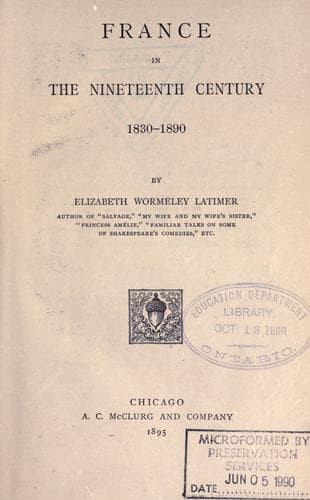
France in the Nineteenth CenturyLatimer, Elizabeth Wormeley
History
France in the Nineteenth Century
Latimer, Elizabeth Wormeley
France -- History -- 1789-1900
Bismarck and Favre presented a great contrast. Bismarck was then
fifty-five years of age; Jules Favre was six years older. Bismarck
wore the uniform of a colonel of White Cuirassiers,--a white coat,
a white cap, and yellow trimmings. He seemed like a colossus, with
his square shoulders and his mighty strength. Jules Favre, on the
contrary, was tall and thin, bowed down by a sense of his position,
wearing a black frock-coat that had become too wide for him, with
his white hair resting on its collar. He was especially urgent that
the National Guard in Paris should retain its arms. He consented
to the disarmament of the Mobiles and the army, but he said it would
be impossible to disarm the National Guard. At length Bismarck
yielded this point, but with superior sagacity remarked: "So be
it. But believe me you are doing a foolish thing. Sooner or later
you will be sorry you did not disarm those unquiet spirits. Their
arms will be turned against you."
When the question was raised concerning the indemnity to be paid
by Paris, Bismarck said, laughing, that Paris was so great a lady,
it would be an indignity to ask of her less than a milliard of
francs ($200,000,000). The ransom was finally settled at two hundred
millions of francs ($40,000,000).
"The dinner-hour having arrived, the chancellor invited us," says
d'Hérisson, "to take seats at his table. Jules Favre, who wanted
to write out carefully the notes I had taken, begged to have his
dinner sent up to him; so I alone followed the chancellor to the
dining-room, where about a dozen military and civil functionaries
were assembled, but all were in uniform. The chancellor, who sat
at the head of the table, placed me on his right. There was plenty
of massive silver, belonging evidently to a travelling case. The
only deficiency was in light, the table being illuminated by only
two wax candles stuck in empty wine-bottles. This was the only
evidence of a time of war."
As soon as the chancellor was seated, he began to eat with a good
appetite, talking all the time, and drinking alternately beer and
champagne from a great silver goblet marked with his initials. The
conversation was in French. Suddenly the chancellor remembered
having met M. d'Hérisson eight years before at the Princess
Mentzichoff's, and their relations became those of two gentlemen
who recognize each other in good society.
The Parisians thought that d'Hérisson had been far too lively on
this occasion; but he feels sure that his sprightly talk and free
participation in the good things of the table, formed a favorable
contrast to the deep depression of Jules Favre at the same board
the day before. "M. de Bismarck," he says, "is not at all like
the conventional statesman. He is not solemn. He is very gay, and
even when discussing the gravest questions often makes jokes, though
under his playful sallies gleam the lion's claws."
Public-domain text, read in full here on John Shaqi.
Reviews
Reviews
No reviews yet
Be the first to share your thoughts on this work.
Elsewhere in the archive
Join the Discussion
Join the discussion
Sign in to leave a comment or review.
Sign InorCreate an account