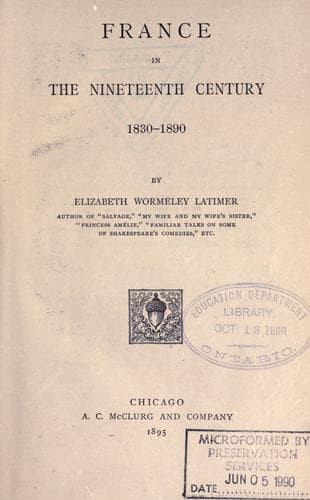
France in the Nineteenth CenturyLatimer, Elizabeth Wormeley
History
France in the Nineteenth Century
Latimer, Elizabeth Wormeley
France -- History -- 1789-1900
But animals which show neither teeth nor claws are seldom left in
peace, and Louis XVIII.'s reign--from 1814 to 1824--was full of
conspiracies. The royalty of the Restoration was only an ornament
tacked on to France. The Bourbon dynasty was a necessary evil, even
in the eyes of its supporters. "The Bourbons," said Chateaubriand,
"are the foam on the revolutionary wave that has brought them back
to power;" whilst every one knows Talleyrand's famous saying "that
after five and twenty years of exile they had nothing remembered
and nothing forgot." Of course the old nobility, who flocked back to
France in the train of the allied armies, expected the restoration
of their estates. The king had got his own again,--why should not
they get back theirs? And they imagined that France, which had
been overswept by successive waves of revolution, could go back
to what she had been under the old régime. This was impossible.
The returned exiles had to submit to the confiscation of their
estates, and receive in return all offices and employments in the
gift of the Government. The army which had conquered in a hundred
battles, with its marshals, generals, and _vieux moustaches_, was
not pleased to have young officers, chosen from the nobility, receive
commissions and be charged with important commands. On the other
hand, the Holy Alliance expected that the king of France would
join the despotic sovereigns of Russia, Austria, and Prussia in
their crusade against liberal ideas in other countries. Against
these difficulties, and many more, Louis XVIII. had to contend.
He was an infirm man, physically incapable of exertion,--a man
who only wanted to be let alone, and to avoid by every means in
his power the calamity of being again sent into exile.
He placed himself on the side of the stronger party,--he took part
with the _bourgeoisie_. His aim, as he himself said, was to _ménager_
his throne. He began his reign by having Fouché and Talleyrand, men
of the Revolution and the Empire, deep in his councils, though he
disliked both of them. Early in his reign occurred what was called
the White Terror, in the southern provinces, where the adherents of
the white flag repeated on a small scale the barbarities of the
Revolution.
The king was forced to put himself in opposition to the old nobles
who had adhered to him in his exile. They bitterly resented his
defection. They used to toast him as _le roi-quand-même_, "the
king in spite of everything." His own family held all the Bourbon
traditions, and were opposed to him. To them everything below the
rank of a noble with sixteen quarterings was _la canaille_.
Public-domain text, read in full here on John Shaqi.
Reviews
Reviews
No reviews yet
Be the first to share your thoughts on this work.
Join the Discussion
Join the discussion
Sign in to leave a comment or review.
Sign InorCreate an account