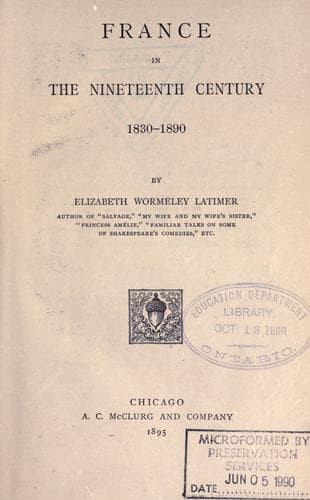
France in the Nineteenth CenturyLatimer, Elizabeth Wormeley
History
France in the Nineteenth Century
Latimer, Elizabeth Wormeley
France -- History -- 1789-1900
Louis XVIII.'s favorite minister was M. Decazes, a man who studied
the interests of the _bourgeoisie_; and the royal family at last made
the sovereign so uncomfortable by their disapproval of his policy
that he sought repose in the society and intimacy (the connection is
said to have been nothing more) of a Madame de Cayla, with whom
he spent most of his leisure time.
Before the Revolution, Louis XVIII. had been known sometimes as
the Comte de Provence, and sometimes as Monsieur. Though physically
an inert man, he was by no means intellectually stupid, for he
could say very brilliant things from time to time, and was very
proud of them; but he was wholly unfit to be at the helm of the
ship of state in an unquiet sea.
He had passed the years of his exile in various European countries,
but the principal part of his time had been spent at Hartwell,
about sixty miles from London, where he formed a little court and
lived a life of royalty in miniature. Charles Greville, when a
very young man, visited Hartwell with his relative, the Duke of
Beaufort, shortly before the Restoration. He describes the king's
cabinet as being like a ship's cabin, the walls hung with portraits
of Louis XVI., Marie Antoinette, Madame Elisabeth, and the dauphin.
Louis himself had a singular habit of swinging his body backward
and forward when talking, "which exactly resembled the heavings
of a ship at sea." "We were a very short time at table," Greville
adds; "the meal was a very plain one, and the ladies and gentlemen
all got up together. Each lady folded up her napkin, tied it round
with a bit of ribbon, and carried it away with her. After dinner we
returned for coffee and conversation to the drawing-room. Whenever
the king came in or went out of the room, Madame d'Angoulême made him
a low courtesy, which he returned by bowing and kissing her hand.
This little ceremony never failed to take place." They finished
the evening with whist, "his Majesty settling the points of the
game at a quarter of a shilling." "We saw the whole place," adds
Greville, "before we came away; they had certainly shown great
ingenuity in contriving to lodge so great a number of people in
and around the house. It was like a small rising colony."
Louis XVIII. was childless. His brother Charles and himself had
married sisters, princesses of the house of Savoy. These ladies were
amiable nonentities, and died during the exile of their husbands; but
Charles's wife had left him two sons,--Louis Antoine, known as the
Duc d'Angoulême, and Charles Ferdinand, known as the Duc de Berri.
The Duc d'Angoulême had married his cousin Marie Thérèse, daughter
of Louis XVI. and Marie Antoinette. Their union was childless. The
Duc de Berri had married Marie Caroline, a princess of Naples.
She had two children,--Louise, who when she grew up became Duchess
of Parma; and Henri, called variously the Duc de Bordeaux, Henri
V., and the Comte de Chambord.
Public-domain text, read in full here on John Shaqi.
Reviews
Reviews
No reviews yet
Be the first to share your thoughts on this work.
Join the Discussion
Join the discussion
Sign in to leave a comment or review.
Sign InorCreate an account