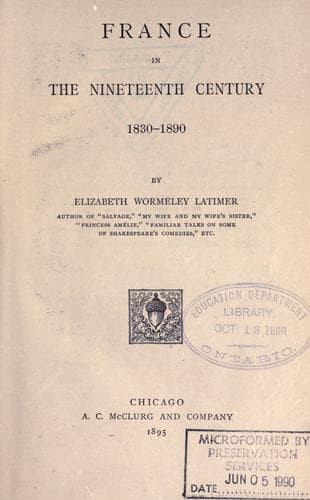
France in the Nineteenth CenturyLatimer, Elizabeth Wormeley
History
France in the Nineteenth Century
Latimer, Elizabeth Wormeley
France -- History -- 1789-1900
Her desire was to leave Blaye before her confinement. In vain she
pleaded her health and a tendency to consumption. The Government
sent physicians to Blaye, among them the doctor who had attended
the duchess after the birth of the Duc de Bordeaux; for it insisted
on having full proof of her disgrace before releasing her. But
before this disgrace was announced in Paris, twelve ardent young
Legitimists had bound themselves to fight twelve duels with twelve
leading men of the opposite party, who might, if she were brought
to trial, injure her cause. The first of these duels took place;
Armand Carrel, the journalist, being the liberal champion, while
M. Roux-Laborie fought for the duchess. The duel was with swords,
and lasted three minutes. Twice Carrel wounded his adversary in
the arm; but as he rushed on him the third time, he received a
deep wound in the abdomen. The news spread through Paris. The prime
minister, M. Thiers, sent his private secretary for authentic news
of Carrel's state. The attendants refused to allow the wounded
man to be disturbed. "Let him see me," said Carrel; "for I have
a favor to ask of M. Thiers,--that he will let no proceedings be
taken against M. Roux-Laborie."
Government after this became anxious to quench the loyalty of the
Duchesse de Berri's defenders as soon and as effectually as possible.
The duel with Armand Carrel was fought Feb. 2, 1833; on the 22d
of February General Bugeaud, commander of the fortress of Blaye,
received from the duchess the following declaration:--
Under the pressure of circumstances and of measures
taken by Government, I think it due to myself and to my
children (though I have had grave reasons for keeping my
marriage a secret) to declare that I have been privately
married during my late sojourn in Italy.
(Signed) MARIE CAROLINE.
From that time up to the month of May the duchess continued to
make vain efforts to obtain her release before the birth of her
child. It had been intimated to her that she should be sent to
Palermo as soon afterwards as she should be able to travel.
The Government took every precaution, that the event might be verified
when it took place. Six or seven of the principal inhabitants of
Blaye were stationed in an adjoining chamber, as is the custom
at the birth of princes.
A little girl having been born, these witnesses were summoned to
the chamber by Madame de Hautfort, the duchess's lady-in-waiting.
The duchess answered their questions firmly, and on returning to
the next room, her own physician declared on oath that the duchess
was the lawful wife of Count Hector Luchesi-Palli, of the family
of Campo Formio, of Naples, gentleman of the bedchamber to the
king of the Two Sicilies, living at Palermo.
Public-domain text, read in full here on John Shaqi.
Reviews
Reviews
No reviews yet
Be the first to share your thoughts on this work.
Join the Discussion
Join the discussion
Sign in to leave a comment or review.
Sign InorCreate an account