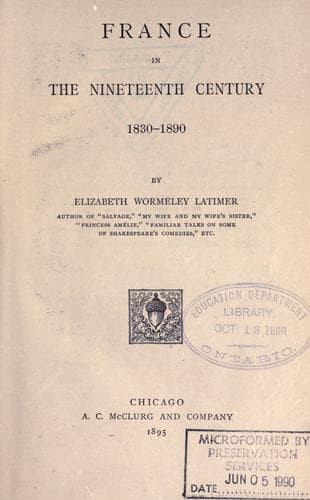
France in the Nineteenth CenturyLatimer, Elizabeth Wormeley
History
France in the Nineteenth Century
Latimer, Elizabeth Wormeley
France -- History -- 1789-1900
This was the first intimation given of the parentage of the child.
A mouth later, Marie Caroline and her infant embarked on board a
French vessel, attended by Marshal Bugeaud, and were landed at
Palermo. Very few of the duchess's most ardent admirers in former
days were willing to accompany her. Her baby died before it was
many months old. Charles X. refused to let her have any further
care or charge of her son. "As Madame Luchesi-Palli," he said,
"she had forfeited all claims to royal consideration."
A reconciliation, however, official rather than real, was patched
up by Chateaubriand between the duchess and Charles X.; but her
political career was over. She was allowed to see the Duc de Bordeaux
for two or three days once a year. The young prince was thenceforward
under the maternal care of his aunt, the Duchesse d'Angoulême. The
Duchesse de Berri passed the remainder of her adventurous life in
tranquillity. Her marriage with Count Luchesi-Palli was apparently
a happy one. They had four children. She owned a palace in Styria,
and another on the Grand Canal at Venice, where she gave popular
parties. In 1847 she gave some private theatricals, at which were
present twenty-seven persons belonging to royal or imperial families.
Her buoyancy of spirit kept her always gay. One would have supposed
that she would be overwhelmed by the fall we have related. She
was good-natured, charitable, and extravagant. She died leaving
heavy debts, which the Duc de Bordeaux paid for her. Her daughter
Louise, sister of the Duc de Bordeaux, married the Duke of Parma,
who was assassinated in 1854. Their daughter married Don Carlos,
who claims at present to be rightful heir to the thrones of France
and Spain. She died in 1864, shortly after the Count Luchesi-Palli.
The Duchesse de Berri, who in her later years became very devout,
_d'après la manière Italienne_, as somebody has said, wrote thus
about his death:--
"I have been so tried that my poor head reels. The loss of my good
and pious daughter made me almost crazy, but the care of my husband
had somewhat calmed me, when God took him to himself. He died like
a saint in my arms, with his children around him, smiling at me
and pointing to heaven."
The duchess died suddenly at Brussels in 1870, aged seventy-one.
"And," adds an intensely Legitimist writer from whom I have taken
these details of her declining years, "had she lived till 1873, she
would have given her son better advice than that he followed."[1]
[Footnote 1: Mémoire de la Duchesse d'Angoulême.]
Without following the ins and outs of politics during the first ten
years of Louis Philippe's reign, which were checkered by revolts,
_émeutes_, and attempts at regicide, I pass on to the next event
of general interest,--the explosion of the "infernal machine" of
Fieschi.
Public-domain text, read in full here on John Shaqi.
Reviews
Reviews
No reviews yet
Be the first to share your thoughts on this work.
Join the Discussion
Join the discussion
Sign in to leave a comment or review.
Sign InorCreate an account