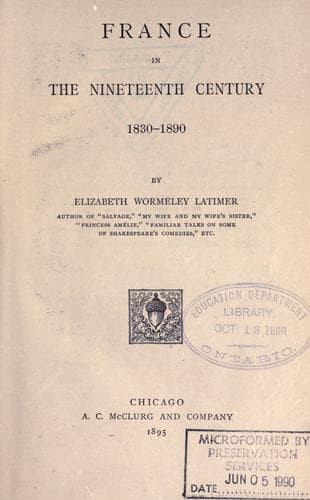
France in the Nineteenth CenturyLatimer, Elizabeth Wormeley
History
France in the Nineteenth Century
Latimer, Elizabeth Wormeley
France -- History -- 1789-1900
It may be desirable to say who were the Carbonari. "Carbone" is
Italian for charcoal. The Carbonari were charcoal-burners. The
conspirators took their name because charcoal-burners lived in
solitary places, and were disguised by the coal-dust that blackened
their faces. It was a secret society which extended throughout
France, Italy, and almost all Europe. It was joined by all classes.
Its members, under pain of death, were forced to obey the orders
of the society. The deliverance of Italy from the Austrians became
eventually the prime object of the institution.
Lafayette, during his visit to America in 1824, expressed himself
freely about the Bourbons. "France cannot be happy under their
rule," he said;[1] "and we must send them adrift. It would have been
done before now but for the hesitation of Laffitte. Two regiments
of guards, when ordered to Spain under the Duc d'Angoulême, halted
at Toulouse, and began to show symptoms of mutiny. The matter was
quieted, however, and the affair kept as still as possible. But
all was ready. I knew of the whole affair. All that was wanted
to make a successful revolution at that time was money. I went
to Laffitte; but he was full of doubts, and dilly-dallied with
the matter. Then I offered to do it without his help. Said I: 'On
the first interview that you and I have without witnesses, put
a million of francs, in bank-notes, on the mantelpiece, which I
will pocket unseen by you. Then leave the rest to me.' Laffitte
still fought shy of it, hesitated, deliberated, and at last decided
that he would have nothing at all to do with it."
[Footnote 1: Vincent Nolte, Fifty Years in Two Hemispheres.]
Here the gentleman to whom Lafayette was speaking exclaimed, "If
any one had told me this but yourself, General, I would not have
believed it."
Lafayette merely answered, "It was really so,"--a proof, thinks
the narrator, how fiercely the fire of revolution still burned
in the old man's soul.
The last months of Louis XVIII.'s life were embittered by changes
of ministry from semi-liberal to ultra-royalist, and by attempts
of the officers of the Crown to prosecute the newspapers for
free-speaking. He died, after a few days of illness and extreme
suffering, Sept. 15, 1824, and was succeeded by the Comte d'Artois,
his brother, as Charles X. This was the third time three brothers
had succeeded each other on the French throne.
Charles X. was another James II., with cold, harsh, narrow ideas
of religion, though religion had not influenced his early life
in matters of morality. He was, as I have said, a widower, with
one remaining son, the Duc d'Angoulême, and a little grandson, the
son of the Duc de Berri. His two daughters-in-law, the Duchesse
d'Angoulême and the Duchesse de Berri, were as unlike each other
as two women could be,--the one being an unattractive saint, the
other a fascinating sinner.
Public-domain text, read in full here on John Shaqi.
Reviews
Reviews
No reviews yet
Be the first to share your thoughts on this work.
Join the Discussion
Join the discussion
Sign in to leave a comment or review.
Sign InorCreate an account