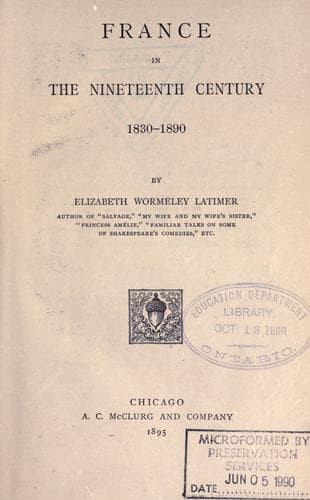
France in the Nineteenth CenturyLatimer, Elizabeth Wormeley
History
France in the Nineteenth Century
Latimer, Elizabeth Wormeley
France -- History -- 1789-1900
All Louis XVIII.'s efforts during his ten years' reign were directed
to keeping things as quiet as he could during his lifetime. He
greatly disapproved of the policy of the Holy Alliance in forcing
him to make war on Spain in order to put down the Constitutionalists
under Riego and Mina. The expedition for that purpose was commanded
by the Duc d'Angoulême, who accomplished his mission, but with
little glory or applause except from flatterers. The chief military
incident of the campaign was the capture by the French of the forts
of Trocadéro, which commanded the entrance to Cadiz harbor.
The Duchesse d'Angoulême, that _filia dolorosa_ left to languish
alone in the Temple after her parents and her aunt were guillotined,
had been exchanged with Austria for Lafayette by Bonaparte in the
treaty of Campo-Formio; but her soul had been crushed within her
by her sorrows. Deeply pious, she forgave the enemies of her house,
she never uttered a word against the Revolution; but the sight
of her pale, set, sad face was a mute reproach to Frenchmen. She
could forgive, but she could not be gracious. At the Tuileries,
a place full of graceful memories of the Empress Josephine, she
presided as a _dévote_ and a dowdy. She could not have been expected
to be other than she was, but the nation that had made her so,
bore a grudge against her. There was nothing French about her. No
sympathies existed between her and the generation that had grown
up in France during the nineteenth century. Both she and her husband
were stiff, cold, ultra-aristocrats. In intelligence she was greatly
the duke's superior, as she was also in person, he being short,
fat, red-faced, with very thin legs.
The Duc de Berri was much more popular. He was a Frenchman in character.
His faults were French. He was pleasure-seeking, pleasure-loving,
and he married a young and pretty wife to whom he was far from
faithful, and who was as fond of pleasure as himself.
The Duc de Berri was assassinated by a man named Louvel, Feb. 13,
1820, as he was handing his wife into her carriage at the door of
the French Opera House. They carried him back into the theatre,
and there, in a side room, with the music of the opera going on
upon the stage, the plaudits of the audience ringing in his ears,
and ballet-girls flitting in and out in their stage dresses, the
heir of France gave up his life, with kindly words upon his dying
lips, reminding us of Charles II. on his deathbed.
As I have said, Louis XVIII.'s reign was not without plots and
conspiracies. One of those in 1823 was got up by the Carbonari.
Lafayette was implicated in it. It was betrayed, however, the night
before it was to have been put in execution, and such of its leaders
as could be arrested were guillotined. Lafayette was saved by the
fact that the day fixed upon for action was the anniversary of his
wife's death,--a day he always spent in her chamber in seclusion.
Public-domain text, read in full here on John Shaqi.
Reviews
Reviews
No reviews yet
Be the first to share your thoughts on this work.
Join the Discussion
Join the discussion
Sign in to leave a comment or review.
Sign InorCreate an account