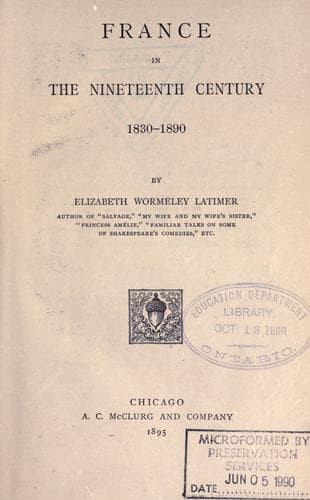
France in the Nineteenth CenturyLatimer, Elizabeth Wormeley
History
France in the Nineteenth Century
Latimer, Elizabeth Wormeley
France -- History -- 1789-1900
Six months later Greville writes: "Nobody has an idea how things
will turn out, or what are Polignac's intentions or his resources."
He appeared calm and well satisfied, saying to those who claimed the
right to question him, that all would be well, though all France
and a clear majority in the Chambers were against him. "I am told,"
says Charles Greville, "that there is no revolutionary spirit abroad,
but a strong determination to provide for the stability of existing
institutions, and disgust at the obstinacy and the pretensions of
the king. It seems also that a desire to substitute the Orleans
for the reigning branch is becoming very general. It is said that
Polignac is wholly ignorant of France, and will not listen to the
opinions of those who could enlighten him. It is supposed that
Charles X. is determined to push matters to extremity; to try the
Chambers, and if his ministers are beaten, to dissolve the House
and to govern _par ordonnances du roi_." This prophecy, written
in March, 1830, foreshadowed exactly what happened in July of the
same year, when, as an outspoken English Tory told Henry Crabb
Robinson, in a reading-room at Florence: "The king of France has
sent the deputies about their business, has abolished the d----d
Constitution and the liberty of the Press, and proclaimed his own
power as absolute king."
"And what will the end be?" cried Robinson.
"It will end," said a Frenchman who was present, "in driving the
Bourbons out of France!"
During the last months of Charles X.'s reign France made an expedition
against the Dey of Algiers, which was the first step in the conquest
of Algeria. The immediate object of the expedition, however, was to
draw off the attention of a disaffected nation from local politics.
An army of 57,000 soldiers, 103 ships of war, and many transports,
was despatched to the coast of Barbary. The expedition was not
very glorious, but it was successful. Te Deums were sung in Paris,
the general in command was made a marshal, and his naval colleague
a peer.
The royalists of France were at this period divided into two parties;
the party of the king and Polignac, who were governed by the Jesuits,
looked for support to the clergy of France. The other party looked
to the army. Yet the most religious men in the country--men like M.
de la Ferronays, for example--condemned and regretted the obstinacy
of the king.
Louis Philippe, the Duke of Orleans, on whom all eyes were fixed,
was the son of that infamous Duke of Orleans who in the Revolution
proclaimed himself a republican, took the name of Philippe Égalité,
and voted for the execution of the king, drawing down upon himself
the rebuke of the next Jacobin whose turn it was to vote in the
convention, who exclaimed: "I was going to vote Yes, but I vote
No, that I may not tread in the steps of the man who has voted
before me."
Public-domain text, read in full here on John Shaqi.
Reviews
Reviews
No reviews yet
Be the first to share your thoughts on this work.
Join the Discussion
Join the discussion
Sign in to leave a comment or review.
Sign InorCreate an account