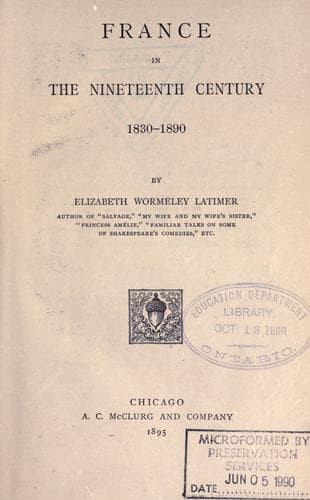
France in the Nineteenth CenturyLatimer, Elizabeth Wormeley
History
France in the Nineteenth Century
Latimer, Elizabeth Wormeley
France -- History -- 1789-1900
Égalité was in the end a victim. He perished, after suffering great
poverty, leaving three sons and a daughter. The sons were Louis
Philippe, who became Duke of Orleans, the Comte de Beaujolais, and
the Duc de Montpensier. One of these had shared the imprisonment
of his father, and narrowly escaped the guillotine.
Louis Philippe had solicited from the Republic permission to serve
under Dumouriez in his celebrated campaign in the Low Countries.
He fought with distinguished bravery at Valmy and Jemappes as
Dumouriez's aide-de-camp; but when that general was forced to desert
his army and escape for his life, Louis Philippe made his escape
too. He went into Switzerland, and there taught mathematics in a
school. Thence he came to America, travelled through the United
States, and resided for some time at Brooklyn.
In 1808 he went out to the Mediterranean in an English man-of-war
in charge of his sick brother, the Comte de Beaujolais. The same
vessel carried Sir John Moore out to his command, and landed him at
Lisbon. Louis Philippe could not have had a very pleasant voyage,
for the English admiral, on board whose ship he was a passenger,
came up one day in a rage upon the quarter-deck, and declared aloud,
in the hearing of his officers, that the Duke of Orleans was such a
d----d republican he could not sit at the same table with him.[1]
[Footnote 1: My father was present, and often told the story]
There used to be stories floating about Paris concerning Louis
Philippe's birth and parentage,--stories, however, not to be believed,
and which broke down upon investigation. These made him out to
be the son of an Italian jailer, exchanged for a little girl who
had been born to the Duke of Orleans and his wife at a time when
it was a great object with them to have a son. The little girl
grew up in the jailer Chiappini's house under the name of Maria
Stella Petronilla. There is little doubt that she was a changeling,
but the link is imperfect which would connect her with the Duke
and Duchess of Orleans. She was ill-treated by the jailer's wife,
but was very beautiful. Lord Newburgh, an English nobleman, saw
her and married her. Her son succeeded his father as a peer of
England. After Lord Newburgh's death his widow married a Russian
nobleman. Chiappini on his death-bed confessed to this lady all he
knew about her origin, and she persuaded herself that her father
must have been the Duke of Orleans. She took up her residence in the
Rue Rivoli, overlooking the gardens of the Tuileries, and received
some small pension from the benevolent royal family of France. She
died in 1845.
Public-domain text, read in full here on John Shaqi.
Reviews
Reviews
No reviews yet
Be the first to share your thoughts on this work.
Join the Discussion
Join the discussion
Sign in to leave a comment or review.
Sign InorCreate an account