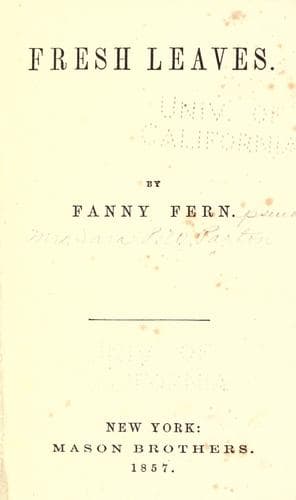
American essays -- 19th century; Short stories, American
I wonder how a man who is eternally
grumbling and growling at every thing the Lord has made, can have the
face to gormandize His good things, as Mr. Doe does. I’d either let ’em
alone, or say Thank you--he don’t do nary one.”
CHAPTER V.
The bleak winds of March were abroad, causing even the healthy and
rugged to shrink from their piercing breath, and fold more closely
around their shivering limbs the warm garments of winter; while the
delicate invalid, warned by his irritated lungs, ventured not beyond
the equable temperature of his closely-curtained chamber.
Mrs. Wade’s accustomed place at the table was vacant; her busy fingers
no longer kept the domestic treadmill in motion. Ah! how seldom we feel
till the “mother” is stricken down, how never-ceasing is the vigilance,
how tireless the patience that ministers to our daily wants;--dropping
noiseless, like the gentle dew, too common and unobtrusive a blessing to
be noticed--till absence teaches us its value.
Death had no terrors for Mrs. Wade. It was only when looking upon the
children whom she must leave behind, that she prayed, with quivering
lips--“Lord, I believe; help Thou mine unbelief!”
If in the thorny path her woman’s feet had trod, her daughter’s
trembling feet must walk! What human arm would sustain her? what human
voice whisper words of cheer? And Neddy--the impulsive, generous,
warm-hearted Neddy; quick to err--as quick to repent--what human hand
would weigh justly in the scales of praise and blame, his daily deeds?
What hand, save a mother’s, in uprooting the weeds, would crush not the
tender flowers? Oh, what mother, while pondering these things in her
heart, and looking round upon the dear faces, in the near or distant
prospect of dissolution, has not felt her heart-tendrils tighten around
them, with a vice-like clasp that almost defied separation? Nature’s
voice is clamorous; but over, and above, and through its importunate
pleadings, comes there to the Christian mother, the still, small
whisper, “My grace is sufficient for thee!”
Mr. Wade at first refused to believe in the reality of his wife’s
sickness. Women, he said, were always ailing, and fancying themselves
dying. But, as the parlor was vacated for the chamber, and the
easy-chair for the bed, and the doctor’s chaise stopped twice a day
before the door, and Mrs. Hereford left her own little family to sit
beside her mother, and Betty wiped her eyes with her apron every time
she left the chamber door--and, more than all, when Mr. Wade’s toast was
not browned as _she_ used to brown it, and his favorite pudding was
wanting, and the lamp burned dimly on the lonely tea-table, and his
slippers were not always in the right place--he resigned himself to what
seemed inevitable, with the air of a deeply-injured man; and slept as
soundly at night, in the room next his wife’s, as if death’s shadow had
not even then fallen across the threshold.
Public-domain text, read in full here on John Shaqi.
Reviews
Reviews
No reviews yet
Be the first to share your thoughts on this work.
Join the Discussion
Join the discussion
Sign in to leave a comment or review.
Sign InorCreate an account