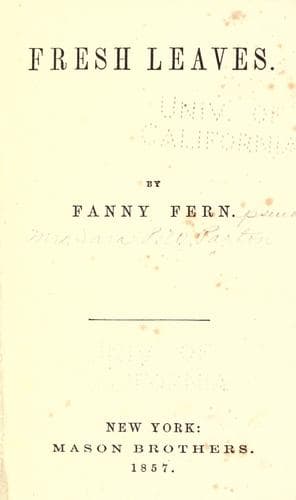
American essays -- 19th century; Short stories, American
“When are you coming to spend the day with us?” asked a lady of my
acquaintance of another. “Spend the day with you, my dear!” replied the
latter; “I should be tired to death spending the day with you; maybe
I’ll take tea with you sometime.”
I have often pleased myself imagining how the wheels of society would
creak greased with such honesty as that! and yet how many, if they but
dared to speak their real sentiments, would make a similar response.
Now, I respect that old lady; she had made good use of her years; she
probably knew what it was to talk at a mark for hours on the stretch, to
some one-idea-d statue, who, with crossed hands and starched attitude,
seemed remorselessly exacting of her weary tongue--Give--Give! She knew
what it was to long for dinner to reprieve her aching jaws, or, at
least, afford them a diversion of labor. She knew what it was to be
gladder to see one’s husband home on such a day, than on any other day
in the year; and she knew what it was to have those hopes dashed to
earth by that inglorious sneak selfishly retreating behind his
newspaper, instead of shouldering the conversation as he ought. She knew
what it was to have the hour arrive for her afternoon nap (I _won’t_
call it “siesta,”) instead of which, with leaden lids, and a great
goneness of brain and diaphragm, she must still keep on ringing changes
on the alphabet, for the edification of the monosyllabic statue,
who--horror of horrors!--had “concluded to stay to tea.” She knew what
it was in a fit of despair to present a book of engravings to the
statue, and to hear that interesting functionary remark as she returned
it, that “her eyes were weak.” She knew what it was to send in for a
merry little chatterbox of a neighbor to relieve guard, and receive for
answer, “that she had gone out of town!” She knew what it was to wish
that she had forty babies up stairs, with forty pains under their
aprons, if need be, that she might have an excuse for leaving the statue
for at least one blessed half-hour. She knew what it was to have the
inglorious sneak later to tea on that wearisome day than ever before;
and on his entrance, blandly and coolly to unfurl a business letter,
which, with a Chesterfieldian bow, he hoped the statue would excuse him
for retiring to answer; and she knew what it was, five minutes later, to
spy the wretch on the back piazza reveling in solitude and a cigar. She
knew what it was, when the statue finally--(for every thing comes to an
end _some time_, thank heaven)--took protracted leave--to cry
hysterically from sheer weariness, and a recollection of pressing family
duties indefinitely postponed, and to think for the forty-eleventh time,
what propriety there was in calling her the _weaker_ sex, who had daily
to shoulder burdens which the strongest man either couldn’t
or--_wouldn’t_ bear. And so again, I say--sensible old lady--would there
were more like her!
Public-domain text, read in full here on John Shaqi.
Reviews
Reviews
No reviews yet
Be the first to share your thoughts on this work.
Join the Discussion
Join the discussion
Sign in to leave a comment or review.
Sign InorCreate an account